Rumors of War
The morning sun was still clawing its way through the smog-filled sky when James Dawkins heard the news. It was passed along in whispers, a ripple of excitement and fear among the men gathered outside the factory gates. War. The United States had declared war on Mexico.
“Another bloody fight,” grumbled Sean O’Donoghue, fiddler turned factory laborer, as he slumped against a brick wall. His Irish brogue was sharp with frustration. “And for what? Land? Power? It’s always the same for them at the top. But for us? Just another way to bleed.”
James stood silently, his arms crossed, listening to the murmurs. The news spread like wildfire: the U.S. wanted to expand, to claim Texas and everything beyond it. Mexico, of course, wouldn’t let that happen without a fight. Men talked of glory and adventure, but James saw something darker in their eyes—desperation.
Recruitment Fever
It wasn’t long before posters appeared on every street corner. Bold black letters promised adventure, steady pay, and a chance to fight for the honor of America. For the Irish immigrants scraping by on crumbs, it was tempting. A soldier’s wage meant food on the table, clothes on their backs, and maybe even enough to send a few dollars home to Ireland.
James studied one of the posters, its edges curling in the damp air. An eagle spread its wings across the top, perched above the words “Enlist Today!” beneath a list of benefits that seemed too good to be true. But what choice did he have?
Still, the decision didn’t come easily. War wasn’t just a job—it was a gamble. Sean voiced what many of them were thinking: “Why fight their war, James? They don’t care for us. They won’t even let us work honest jobs without spitting on us. What makes you think they’ll treat us better in their bloody army?”
But there was another side to the argument, one voiced by a younger man named Michael Burke, fresh off the boat from Cork. “What else is there?” he asked, his voice cracking with the weight of his youth. “It’s this or starve. At least in the army, they feed you.”
James stayed quiet, his thoughts churning. He knew Sean was right. The Americans didn’t care for the Irish—they barely saw them as human. But Michael wasn’t wrong either. The thought of steady pay, of not having to claw his way through each day, was enough to make James linger on the poster longer than he should have.
The Parade of Promises
The recruiters came days later, dressed in polished boots and sharp uniforms. They stood tall, their voices booming as they addressed the gathered crowd.
“Men of courage! Men of honor! Your country needs you!” one of them shouted, his mustache twitching with each word. He painted a vivid picture of valor on the battlefield, of standing shoulder to shoulder with brothers in arms, of earning respect and riches through service.
James watched as the crowd leaned in, hungry for every word. He could see the desperation in their faces, the quiet surrender to the idea that this might be their only chance to escape the grind of survival.
But as the recruiter spoke, James’s mind wandered. Your country, he thought bitterly. Is it ours? Or do you just need bodies for your war?
An Uneasy Alliance
The Irish weren’t the only ones being recruited. Germans, Italians, free Black men, and even a few Native Americans filled the ranks, a patchwork army united not by patriotism, but by poverty. They came from different corners of the city, their accents clashing in a cacophony of frustration and hope.
Among them was a man named Samuel Price, a former slave who had escaped to the North and was now searching for a way to make a life. He stood tall, his presence commanding, and when he spoke, men listened.
“They promise us freedom,” Samuel said one night, his voice low but firm. “They promise us honor. But what they really want is cannon fodder. Still… a man’s gotta eat.”
His words struck a chord with James. There was truth in them—cold, hard truth. But even as the cynicism set in, James couldn’t ignore the flicker of hope that came with the idea of leaving behind the factory and the railroads, if only for a while.
The Decision
One evening, as the sun set behind the smokestacks, James found himself walking toward the recruiter’s table. His steps were heavy as if each one carried the weight of every Irishman who had ever been forced to choose between suffering and survival.
Sean caught up with him, grabbing his arm. “James don’t do this. You’ve got a head on your shoulders—use it. This isn’t your war.”
James turned; his face lined with exhaustion. “It’s not about their war, Sean. It’s about what I can bring home. For Mam. For Mary. For all of them. Maybe this isn’t my fight, but it’s my chance.”
Sean let go, his shoulders slumping. “If you’re going, don’t forget who you are. Don’t let them make you into something you’re not.”
With those words echoing in his ears, James signed his name.
The Beginning of Something Bigger
That night, James sat by the fire, his enlistment papers tucked into his coat. Around him, men talked of glory, fear, and uncertainty. Samuel was sharpening a knife, his expression unreadable. Michael Burke sat cross-legged, his hands trembling as he held the enlistment bonus—a few coins that would barely buy him a meal, but to him, it was a fortune.
“Do you think it’ll be worth it?” Michael asked, his voice barely audible.
James didn’t answer right away. He stared into the flames, thinking of Ireland, of the family he’d left behind, of the promise he’d made to himself to be more than just another body in the crowd.
“I don’t know,” he said finally. “But I think it’s better than staying here and wondering what could’ve been.”
A New Path
The rumors of war were no longer just whispers. They were reality. And as James lay down that night on the cold, hard ground, he felt the stirrings of something new—not hope, exactly, but resolve. He didn’t know what awaited him on the battlefield, but he knew one thing: he would face it with the same grit that had carried him across the Atlantic, through the streets of New York, and into the promise of a future that was still his to claim.
It wasn’t just a decision to fight, it was a decision to survive. And that, James realized, was a battle worth waging.
Disclaimer
This book, James Dawkins: A Legacy of Survival, Sacrifice, and Southern Tradition, is a blend of historical research, family lore, cultural analysis, and creative storytelling. While great care has been taken to present historical events accurately, some elements—such as personal accounts, conversations, and character perspectives—are dramatized to bring the narrative to life and provide a deeper emotional connection to the events described.
The recipes and traditions included in this book are shared for cultural and educational purposes. They are drawn from personal and regional traditions, as well as historical sources, and may vary depending on individual practices and interpretations.
The author, A.L. Childers, is not a professional historian or genealogist but a passionate writer committed to exploring the cultural and historical roots of Southern experience. This book is not intended to serve as an authoritative historical text but as a celebration of heritage, resilience, and family. Readers seeking in-depth historical analysis are encouraged to consult additional scholarly sources.
The opinions and interpretations expressed in this book are those of the author and do not represent the definitive perspective on any historical or cultural topic. Readers are encouraged to explore their own family histories and cultural traditions, taking inspiration from this work to celebrate and preserve their unique stories.
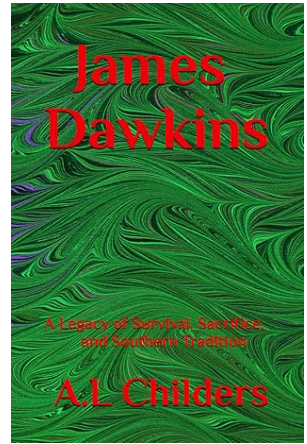
James Dawkins: A Legacy of Survival, Sacrifice, and Southern Tradition