There’s a particular kind of loneliness that hits when you realize no one’s texting to ask if you want to join them for dinner, a concert, or a simple Saturday coffee. It’s not about wanting a party every weekend — it’s about wanting connection. That warm feeling of being wanted, thought of, and included.
If you’ve ever sat at home and thought, “It would be nice to be invited somewhere…”, you’re not alone. So many adults — especially in their 30s, 40s, 50s and beyond — quietly feel disconnected but don’t know where to start rebuilding their social circles.
The good news? You can make meaningful friendships later in life. It just looks different than it did in school or your 20s — and that’s okay.
🌱 Why Adult Friendships Are Harder
Life pulls people in different directions. Careers, kids, health, relationships, caregiving — there’s less “free time” for casual socializing.
Friend groups shift. Sometimes friendships fade without drama; people just grow apart.
It can feel awkward to initiate. As adults, many of us fear rejection or think, “They probably already have their own friends.”
None of these mean you’re unlikable or “too late.” They’re just the reality of how life changes.
🛠 Practical Ways to Build New Friendships
1. Start With Shared Interests
It’s easier to bond when you already have common ground. Consider:
Classes & Workshops: Art, cooking, dance, language, fitness, writing, gardening — local community colleges and recreation centers are goldmines.
Volunteer Work: Helping at animal shelters, food banks, libraries, or community events naturally connects you to kind-hearted people.
🔸 Pro tip: Don’t go once and give up. Friendships grow with repeated contact. Think “planting seeds,” not “lightning strikes.”
2. Reach Out to Old Connections
Sometimes, friendships don’t end — they just drift. A simple message like, “Hey, I was thinking about you and wondered how you’re doing,” can reopen doors more often than you’d expect. Most people are grateful to be remembered.
3. Be the One Who Invites
Many people are waiting to be invited, just like you are. Taking the first step can feel scary, but small invitations — coffee, a walk, a movie — often lead to deeper bonds. Remember: a “no” doesn’t mean they don’t like you; it might just be bad timing. Keep trying.
4. Look for Ongoing Communities, Not One-Off Events
Regularly showing up to something — a weekly class, a recurring volunteer gig, a faith group, a neighborhood gathering — is where friendships naturally form. Consistency builds familiarity, and familiarity builds trust.
5. Online Can Lead to Offline (Safely)
Facebook Groups for local hobbies, community events, or women’s/men’s circles can lead to real-world meetups.
Bumble BFF or Friender apps are designed for making platonic friends.
Niche forums and Discord groups can also lead to meaningful offline connections when approached thoughtfully.
❤️ Emotional Reminders
You’re not broken for feeling lonely.
It’s okay to grieve friendships that never happened or faded away.
You deserve connection just as much as anyone else.
It may take time, but it is possible — and often, just one or two genuine friendships can change how life feels.
📚 Resources to Help You Find Your People
Meetup.com — Find groups by interest and location.
Nextdoor — Neighborhood-based networking for local events.
Local community centers, libraries, and recreation departments often have bulletin boards with upcoming clubs and classes.
If social anxiety is part of the challenge, organizations like the National Alliance on Mental Illness (NAMI) offer free support groups and resources to help build confidence in social situations: https://www.nami.org.
✨ You Deserve Invitations, Too
Friendships in adulthood take intention — but they also often bring deeper, more meaningful bonds than those of youth. If you’ve been feeling like no one thinks of you, know this: you matter, and it’s not too late to find your people.
The first step might be small, but it’s a step toward connection — and you’re worthy of that.
Four hundred years ago, if you so much as brewed a cup of herbal tea while muttering to yourself, congratulations — you were a prime suspect for witchcraft. 🧙♀️ Fast forward to today, and you can dance under the moon, write affirmations, light all the candles your fire alarm will tolerate, and call it “Tuesday self-care night.”
Progress, baby. 🙌
The Original “Cancel Culture” Was… Fiery
Between the 15th and 18th centuries, thousands of people — mostly women — were accused of witchcraft in Europe and Colonial America. Some were herbalists, some midwives, some simply owned a black cat that looked at the wrong person the wrong way.
⚡ Things that might’ve gotten you in trouble back then:
Owning more than three cats 😼
Talking to yourself in the garden (aka praying or manifesting)
Healing a neighbor’s rash with lavender
Knowing the phases of the moon
Not knowing the phases of the moon (truly a no-win situation)
Being a woman with opinions 🫢
In some regions, even baking an unusually good loaf of bread could raise eyebrows. Imagine being taken to trial for having exceptional sourdough starter skills. “She must have made a pact with the yeast spirits!”
✨ Modern Witchy Acts That Would’ve Sparked a Bonfire Back Then
Charging your crystals on the windowsill 🪄
Lighting candles while saying affirmations (or, you know, just lighting candles)
Googling “moon water recipes”
Running a TikTok astrology account 🌌
Voting, reading, or having a Wi-Fi connection
These days, we embrace individuality, spirituality, and science — things that would’ve been misunderstood centuries ago. What was once “heresy” is now “Etsy.”
📝 A Little Historical Context
The infamous witch trials (think Salem 1692, or Germany during the Würzburg trials) were driven by fear, politics, religious control, and in many cases — good old-fashioned gossip. The “Malleus Maleficarum” (1487), a book written by Heinrich Kramer, gave witch-hunting a kind of legal manual, blending superstition with authority.
Ironically, many accused witches were simply practicing early forms of what we now call folk medicine, holistic healing, or spiritual rituals. Others were victims of property disputes, jealous neighbors, or being a bit “too independent” for their time.
🌿 Why This Message Still Hits Today
The quote, “Do something today that would’ve gotten you burnt at the stake 400 years ago,” isn’t just cheeky — it’s empowering. It reminds us to:
Embrace your individuality without fear.
Celebrate the freedoms we often take for granted.
Honor the people in history who dared to be different — and paid the price so we could light our pumpkin spice candles in peace.
So go ahead — say your affirmations, wear that wide-brimmed hat, read your tarot cards, or invent something revolutionary. Four hundred years ago, you’d be on trial. Today, you’re trending. 🔮✨
📚 About the Author
Audrey Childers (A.L. Childers) is a writer, researcher, and unapologetic history nerd with a love for uncovering forgotten truths and laughing along the way. Her books explore everything from spiritual awakenings to hidden historical narratives — always with a blend of depth, wit, and soul.
⚠️ Disclaimer
This blog is for educational and entertainment purposes. Historical events mentioned are factual, but the commentary is intended to bring humor and light to dark parts of history. No actual witch trials were conducted in the making of this blog. 🔥
📝 References & Resources
Malleus Maleficarum (1487) – Heinrich Kramer
Levack, Brian P. The Witch-Hunt in Early Modern Europe (1987)
Salem Witch Trials Documentary Archive and Transcription Project, University of Virginia
Gaskill, Malcolm. Witchfinders: A Seventeenth-Century English Tragedy (2005)
📢 Why You’ll Love My Books
If you enjoy history with a twist — the untold stories, the spiritual threads, the humor tucked between the lines — my books will feel like a conversation with your most interesting friend.
✨ So go on — light that candle, speak your truth, and make some historical trouble today.
Throughout history, humanity has used different languages, rituals, and belief systems to describe the same unseen force — an energy that flows through us, around us, and often responds to our intentions.
The image above captures this beautifully:
“Witches call it spells. Christians call it prayer. Spiritualists call it manifestation. Atheists call it the placebo effect. Scientists call it quantum physics. Everyone’s arguing over its name. No one is denying its existence.”
Across centuries, cultures have pointed to something beyond the physical — a mysterious yet powerful force that can heal, inspire, transform, and unite.
🧙♀️ Witches Call It Spells
In ancient pagan and folk traditions, “spells” were not about dark magic, but about focused intention. Whether lighting a candle, chanting words, or using herbs, spellwork was a structured way to channel desire into action. Anthropologists have documented spellcraft across civilizations — from the Greeks invoking Hecate to medieval cunning folk helping villages with healing charms.
👉 Fun fact: Many early “spells” were simply prayers or petitions written in poetic language — something not so different from affirmations today.
✝️ Christians Call It Prayer
Prayer has been a cornerstone of Christianity for over two millennia. From whispered prayers of early believers in Roman catacombs to grand cathedral ceremonies, prayer is viewed as a direct line to the divine. Studies have shown that prayer can reduce stress, promote healing, and even bring communities together during crises.
👉 Historical note: The earliest Christian prayers were adapted from Jewish traditions, blending ritual with heartfelt devotion — another example of universal energy expressed through culture.
✨ Spiritualists Call It Manifestation
Modern spiritual movements, especially those influenced by New Thought philosophy in the late 19th and early 20th centuries, began using the word “manifestation” to describe consciously shaping reality. Authors like Wallace Wattles and Neville Goddard popularized the idea that focused thought can bring about change. Today, this concept thrives in the form of vision boards, affirmations, and “law of attraction” practices.
👉 The core idea is the same: energy follows intention.
🧠 Atheists Call It the Placebo Effect
Even without religious or spiritual beliefs, the power of the mind is undeniable. The placebo effect — documented extensively in modern medicine — shows that belief alone can trigger physiological changes. Patients given sugar pills often experience real healing because their minds expect improvement.
👉 It’s not magic — it’s the brain’s ability to influence the body.
⚛️ Scientists Call It Quantum Physics
While quantum physics doesn’t “prove” manifestation or magic, it does reveal a strange, interconnected universe where observation affects reality. Phenomena like the observer effect and quantum entanglement have sparked philosophical debates for decades.
Some theorists and spiritual thinkers believe these discoveries offer a scientific lens through which to view age-old mystical concepts.
🌐 One Force, Many Names
No matter what you call it, the idea remains: there is a shared energy connecting all things. Across time and culture, humans have tried to explain and harness it — through spells, prayers, rituals, affirmations, experiments, or pure belief.
Instead of arguing over terminology, perhaps it’s more powerful to recognize the common thread. We’re all participating in the same mystery, just using different languages.
📚 About the Author
Audrey Childers (A.L. Childers) is a writer, researcher, and seeker of timeless truths. Her work explores the intersection of history, spirituality, science, and personal transformation. She has authored numerous books on hidden histories, spiritual awakenings, health, and cultural evolution — inviting readers to see the world through a deeper lens.
📝 Disclaimer
This blog explores cultural, historical, and philosophical perspectives for educational and inspirational purposes. It is not intended as medical, scientific, or religious advice. Always consult appropriate professionals for guidance in those areas.
📚 References & Resources
Frazer, James. The Golden Bough (1890) – Classic anthropological work on magic and religion
Goddard, Neville. Feeling is the Secret (1944) – Manifestation philosophy
New Testament (Multiple passages on prayer and faith)
Benson, Herbert. “The Relaxation Response.” Harvard Medical School (1970s) – Mind-body research
Einstein, A. & Bohr, N. – Early 20th-century debates on quantum theory
📢 Explore My Books
If you’re fascinated by how spirituality, history, and science intertwine, my books take you on unforgettable journeys through time, belief, and hidden knowledge. Each title uncovers layers of human experience that mainstream narratives often overlook.
👉 Browse my collection on Amazon and find your next transformative read today.
Few songs can instantly lift your mood, get your feet tapping, and unite people across generations. But in 1983, one song did just that — “Holiday” by Madonna. Bursting onto the airwaves with infectious beats, celebratory lyrics, and a vibrant sense of freedom, this track became much more than a hit single. It became a cultural movement.
🎶 A Song That Defined an Era
Released on September 7, 1983, “Holiday” was Madonna’s first mainstream hit in the United States. Written by Curtis Hudson and Lisa Stevens of Pure Energy and produced by John “Jellybean” Benitez, the track was originally offered to other artists — but none gave it the spark that Madonna did.
When her vocals met the track’s upbeat synth-pop rhythm, something magical happened. “Holiday” shot up to No. 16 on the Billboard Hot 100 and became a global dance-floor sensation. For many fans, this was the moment Madonna went from a rising club singer to a bona fide pop icon.
🪩 Why People Loved It So Much
Escapism in a Song: The early ’80s were marked by political tension, economic uncertainty, and cultural shifts. “Holiday” offered listeners a joyful escape — a few minutes where “it would be, it would be so nice.”
Timeless Dance Energy: The synth beats and handclaps still sound fresh today. DJs continue to spin “Holiday” at retro nights, pride parades, weddings, and festivals around the world.
Universal Message: You didn’t need to understand subculture, politics, or fashion to love this song. Its call to take a break, celebrate life, and dance resonated with everyone — and still does.
Madonna’s Charm: This song showcased Madonna’s natural charisma. She wasn’t just singing; she was inviting the world to join her.
🌍 The Cultural Impact
Fashion & Freedom: Madonna’s early style — fingerless gloves, layered jewelry, lace, and street fashion — paired perfectly with the carefree vibe of “Holiday.” Young women everywhere mimicked her look.
MTV Revolution: The song’s popularity was fueled by MTV’s growing dominance, helping Madonna become one of the network’s most featured stars.
Global Reach:“Holiday” became Madonna’s first hit single in countries like the UK, setting the stage for her world domination throughout the ’80s and beyond.
📚 Why This Matters Today
In a world full of stress, deadlines, and constant noise, the message of “Holiday” is more relevant than ever:
“If we took a holiday — took some time to celebrate — just one day out of life — it would be, it would be so nice.”
It reminds us that joy, celebration, and community are timeless needs.
📚 About the Author
Audrey Childers (also known as A.L. Childers) is an author, researcher, and cultural storyteller who blends history, music, and personal insight to bring the past to life. She writes across genres—from historical exposés to health guides and spellbinding fiction—inviting readers to see the world through a sharper, more vibrant lens.
📢 Disclaimer
This blog is for informational and educational purposes only. It references historical and cultural sources to provide context about Madonna’s song “Holiday.” All music rights belong to their respective copyright holders.
📚✨ Why You Should Check Out My Books
If you love deep dives into culture, history, and the untold stories behind the music, politics, and health trends that shaped our world — my books are written for you. From uncovering hidden empires to exploring the spiritual side of human history, each title is crafted to inform, inspire, and entertain.
👉 Explore my growing collection on Amazon and discover your next favorite read.
📝 References & Resources
Billboard Archives (1983)
MTV History & Pop Culture Impact Reports
Curtis Hudson & Lisa Stevens Interviews, 1983–1995
Because sometimes, a bubble bath and a little intention can shift your entire energy field.
Discover a simple yet powerful ritual bath spell to break negative contacts, plus 4 more cleansing rituals to restore your energy, release attachments, and invite light back into your life.
🌿 The Night the Energy Felt Heavy
It was one of those evenings where the air felt thick—like the room itself was carrying someone else’s mood. I had just come home from a draining conversation that left my chest tight, my thoughts tangled. Even after the person was gone, their energy wasn’t.
I drew a hot bath. The sound of water filled the silence like a steady heartbeat. On the counter sat a small bowl of pink salts, a scoop of baking soda, and the intention that tonight…I’d let go.
As I held my right hand over the mixture, I closed my eyes and pictured a stream of white light pouring down through my palm, infusing the salts with warmth. The moment I poured them into the water, the room seemed to hum. Steam rose like a veil. I stepped in.
“As this water washes over me, I break contact with all negativity.”
I whispered it once, then again. By the third time, the heaviness had begun to loosen its grip.
🛁 Spell to Break Negative Contacts
Ingredients:
1 hot bath
1 cup Epsom or Dead Sea salts
1 cup baking soda
Instructions:
Hold your right hand over the salts and visualize purifying white light flowing into them.
Pour the salts and baking soda into your bath and swirl them clockwise.
Step into the bath and, as you pour water over your body, repeat aloud: “As this water washes over me, I break contact with all negativity.”
Close your eyes. See yourself surrounded by a glowing white light, dissolving cords, attachments, or stagnant energy.
When you’re done, drain the water and imagine everything you released swirling away down the drain.
🌿 Why this works: Ritual bathing is one of the oldest spiritual practices—used in Babylon, Ancient Greece, and Indigenous cultures—to symbolically cleanse the spirit and body. Salt neutralizes energy, while water carries it away.
🪄 4 More Cleansing Spells to Restore Your Energy
1. 🕯️ The Black Candle Burn
Light a black candle (symbol of banishing) and place it on a fireproof plate.
Write the name or situation you want to release on a small piece of paper.
Fold it away from you three times, place it under the candle, and let the wax drip over it as you say: “What was tied is now released. What was heavy is now light.”
Let the candle burn safely down. Dispose of the paper outside or bury it.
📝 Why it works: Black candles are traditionally used to absorb and neutralize negativity, making this spell a favorite for energy workers.
2. 🌬️ The Cord Cutting Visualization
Sit quietly. Picture a cord of energy connecting you to the person or situation.
Visualize holding a golden pair of scissors.
With love and clarity, cut the cord, watching both ends retract and heal with light.
Say: “I release you with love. I reclaim my energy now.”
✨ Why it works: This method is rooted in modern energy healing but mirrors ancient symbolic “severing” rituals used across cultures to break unhealthy attachments.
3. 🍃 The Herbal Sweep
Bundle cleansing herbs like rosemary, lavender, sage, or cedar with a natural string.
Sweep the bundle gently over your body from head to toe while repeating: “With this sweep, I clear and release what does not serve me.”
Hang the herbs to dry outside afterward to release the absorbed energy.
🌿 Why it works: Herbal cleansing is an ancient European, Indigenous, and Mediterranean practice believed to bind and absorb negative influences.
4. 🧂 The Doorway Salt Line
Sprinkle a thin line of salt across doorways and windowsills while saying: “Only peace may enter here. Only love may remain.”
Leave overnight, then sweep up and discard outside.
🧂 Why it works: Salt has been used in folk magic, Shinto, and Mediterranean traditions to create protective barriers against negative energies and spirits.
Modern energy healing practices and cord-cutting visualizations
⚠️ Disclaimer
This article is intended for spiritual, cultural, and personal development purposes only. It is not medical advice. If you’re experiencing emotional or mental distress, please consult a qualified healthcare or mental health professional.
✍️ About the Author – Audrey Childers
Audrey Childers is a writer, spiritual researcher, and storyteller who blends ancient wisdom with modern life. She explores history, ritual, and personal empowerment through her books and blogs—always with a touch of magic and truth.
📸 Image Suggestions
A soft-lit bathroom with Epsom salts and candles (Unsplash/Pexels)
A black candle burning in a quiet room
Herbal bundles tied with twine on a rustic table
A symbolic image of white light surrounding a person in meditation
Vintage illustrations of ritual baths or salt cleansing (public domain)
bath spell to break negative contacts • cleansing rituals • energy cord cutting • salt bath spiritual • black candle banishing spell • herbal energy cleansing • spell for negative attachments • folk magic traditions • modern spiritual cleansing • Audrey Childers witchy blog
PFAS in Sea Foam, Ocean Pollution, and the Global Fallout of Neglect
🌊 A Shocking Discovery on the Carolina Coast
CAROLINA BEACH, NC — A recent study has sent shockwaves through North Carolina’s coastal communities. According to environmental watchdog group Clean Cape Fear, alarming concentrations of PFAS (per- and polyfluoroalkyl substances)—commonly known as “forever chemicals”—have been found in sea foam samples collected from Oak Island and Carolina Beach State Park.
Unlike typical water contaminants, PFAS don’t easily dissolve. Instead, they float on the surface and accumulate when wind and waves churn seawater into foam, concentrating these persistent pollutants at levels significantly higher than in the surrounding water.
Emily Donovan, co-founder of Clean Cape Fear, voiced public concern:
“A lot of the feedback that we’ve gotten with this research is just really important concerning questions of ‘is it safe to go swimming in the ocean, is it safe to touch the foam?’ and the unfortunate thing right now is we really don’t know.”
🧪 What Exactly Is Sea Foam — and Why Does It Matter?
Sea foam is a natural phenomenon, formed when dissolved organic matter in seawater is agitated by wind and surf. This agitation traps air, creating bubbles that accumulate into foam. Under normal conditions, this foam isn’t dangerous—it’s simply the ocean “frothing” at the surface.
However, when industrial chemicals like PFAS are present in the water, sea foam becomes a concentrated carrier of toxins, capable of clinging to sand, skin, and even entering the air through aerosolization, where microscopic particles are carried by sea spray.
A 2022 study published in Environmental Science & Technology found that PFAS concentrations in sea foam can be hundreds of times higher than in the water itself. This means that children playing on the beach, dogs running through foam, or adults lounging near the surf could unknowingly come into contact with dangerous chemicals.
☢️ Global Fallout: Could Radiation and Industrial Waste Be Adding to the Problem?
While PFAS contamination is primarily linked to local and regional industrial discharges—such as those from chemical manufacturing plants, airports (due to firefighting foams), and wastewater systems—ocean currents don’t respect borders.
1. Fukushima and Trans-Pacific Drift
After the 2011 Fukushima Daiichi nuclear disaster in Japan, radioactive contaminants were released into the Pacific Ocean. While international monitoring agencies like NOAA and the IAEA have reported that radiation levels in U.S. coastal waters remain below harmful thresholds, trace amounts of cesium-134 and cesium-137 isotopes were detected on the West Coast of the U.S. in subsequent years.
Though PFAS and radioactive isotopes are chemically different, their combined presence in marine ecosystems raises concerns about the cumulative impact of global contamination.
2. Industrial Pollution and Ocean Dumping
For decades, corporations around the world have legally and illegally dumped hazardous waste into oceans. Examples include:
DuPont and Chemours releasing PFAS into the Cape Fear River in NC for decades.
Oil refineries discharging benzene and heavy metals into waterways.
Shipping industries releasing bilge water containing chemicals, oil, and plastics.
Textile factories in Asia discharging untreated dye and chemical runoff into rivers that feed into the oceans.
Once these pollutants enter the ocean, they travel via currents, settle in sediments, bioaccumulate in marine life, and resurface in unexpected places—like the sea foam of Carolina Beach.
📚 Historical Context: How Did We Get Here?
The term “forever chemicals” refers to PFAS compounds that don’t break down naturally. First developed in the 1940s, PFAS were used in:
Non-stick cookware (Teflon)
Waterproof clothing
Stain-resistant fabrics
Firefighting foams
Food packaging
For decades, these chemicals were marketed as safe, even as internal studies by manufacturers revealed their persistence and potential health risks. By the 2000s, PFAS had spread globally, found in polar bears, rainwater, drinking water, and human bloodstreams.
The EPA only began taking significant action in the 2010s, issuing health advisories and pressuring companies to phase out certain PFAS. However, many “replacement PFAS” are just as persistent, and no enforceable federal drinking water standard for most PFAS existed until 2024.
🌍 Health Implications of PFAS Exposure
Scientific studies have linked long-term PFAS exposure to:
Cancer (kidney, testicular, liver)
Thyroid dysfunction
Hormone disruption
Reduced immune response
Reproductive issues
Developmental delays in children
Because PFAS can enter the human body through skin contact, inhalation of sea spray, or ingestion, beachgoers in affected areas are right to be concerned.
📝 What Can Be Done?
Avoid direct contact with sea foam, especially for children and pets.
Rinse off thoroughly after visiting beaches known to have PFAS contamination.
Support local advocacy groups like Clean Cape Fear.
Push for stronger regulation and cleanup, including holding polluters accountable.
Stay informed: monitor advisories from state environmental agencies.
International Atomic Energy Agency (IAEA) – Fukushima Monitoring Data
📢 SEO Keywords:
PFAS in North Carolina beaches, toxic sea foam, forever chemicals NC coast, Cape Fear River pollution, Fukushima radiation US ocean, PFAS health risks, Oak Island contamination, Carolina Beach State Park PFAS, ocean pollution history, toxic waste dumping examples
⚠️ Disclaimer
This article is for informational and educational purposes only. It is not intended to provide medical or legal advice. Readers are encouraged to consult official environmental health resources and experts for guidance related to PFAS exposure and safety recommendations.
✍️ About the Author – Audrey Childers
Audrey Childers is a writer, researcher, and environmental advocate based in North Carolina. Known for her investigative approach and compelling storytelling, she explores the intersections of health, history, and environmental justice. Through her books and blogs, Audrey sheds light on hidden truths that shape our modern world—empowering readers with knowledge and action.
Toxic PFAS “forever chemicals” have been found in sea foam along NC beaches. Learn the history, dangers, and global pollution sources behind this crisis.
1. Sitting on the Beach (Away from Foam) Is Generally Low-Risk
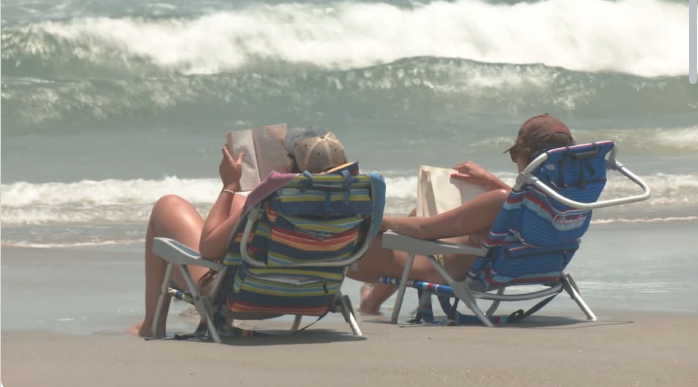
If you’re just sitting on dry sand or a towel, enjoying the sun while the waves lap at your feet (and you’re not in direct contact with visible sea foam), your exposure to PFAS is likely very minimal.
PFAS don’t evaporate into the air like volatile chemicals.
Most exposure happens through direct skin contact, ingestion, or inhalation of sea spray near contaminated foam.
If you’re positioned a little farther back from the foam line, risk is significantly reduced.
☀️ Pro Tip: Bring a beach chair or mat and sit a few feet back from where foam tends to collect. PFAS often accumulate in the surf zone where bubbles gather, not in clean dry sand.
🌬️ 2. Be Aware of Sea Spray and Wind Direction
PFAS can aerosolize in sea spray—tiny droplets of water carried by wind. This doesn’t mean sitting by the ocean is dangerous, but:
If there’s a lot of wind blowing foam or mist toward you, it’s better to move slightly inland.
On calm days, the risk is far lower.
Children and pets playing right in the foam, however, can have higher exposure due to closer contact and hand-to-mouth behaviors.
🧍♀️ 3. Wading in Clear Water vs. Foam
If you decide to walk in shallow water where there’s no visible foam, the PFAS concentration is likely much lower. The concerning levels are mainly in the foam itself, which can contain hundreds of times more PFAS than the surrounding water.
👉 If you do go in the water:
Rinse off thoroughly with clean water afterward.
Avoid swallowing any seawater.
Wash your swimsuit and towel once you’re home.
📌 4. Local Advisories Matter
Keep an eye on updates from:
NC Department of Environmental Quality (NC DEQ)
Clean Cape Fear
EPA PFAS advisories
If they issue warnings about specific beaches or foam events, follow their guidance. Sometimes they’ll recommend avoiding contact during heavy foam blooms but won’t restrict sunbathing or walking near the shore.
⚠️ Bottom Line
✅ Yes, it’s generally safe to sit out, tan, and enjoy the waves at NC beaches — as long as you avoid direct contact with sea foam and heavy sea spray. 🚫 Avoid letting kids or pets play in or near foam. 🚿 Rinse off after beach time to minimize any incidental exposure.