
A story of words, women, children, and who the law was really built to protect
The room smells of ink and hot wax. Paper rustles beneath careful hands. Outside, horses stamp against frozen ground and the low murmur of men arguing drifts through wooden walls. It is the late eighteenth century, and a nation is being invented—not only with muskets and blood, but with language.
George Washington lifts his pen and writes a phrase he will later abandon:
“Citizens of America.”
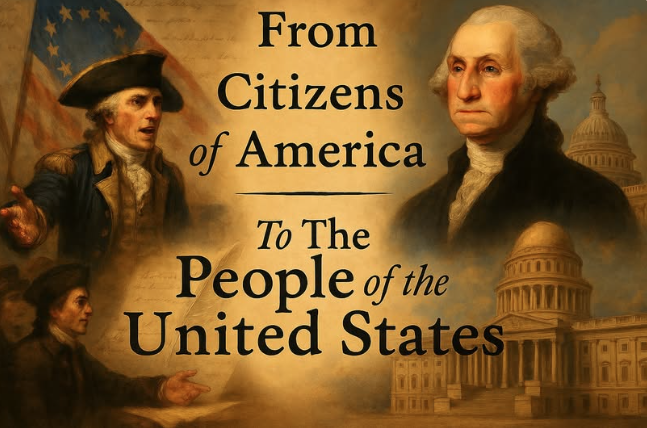
At the time, it is not a legal term. It has no teeth. No statute. No uniform meaning. It is a rallying cry—an emotional banner meant to bind farmers, tradesmen, immigrants, and rebels together against a crown. To Washington, “American” is not birthplace or bloodline. It is participation. Sacrifice. Risk.
You are American because you stood there when it mattered.
But once the war ends, words harden. The fire cools. And the same language that once united begins to sort, exclude, and restrain.
When a Citizen Became a Subject
The Revolution promised liberty, but the law inherited something older—English common law, where citizenship and subjecthood were never far apart. To be a “citizen” did not mean sovereignty over oneself. It meant allegiance. Obligation. Legal placement within a hierarchy.
And for women, marriage quietly erased what little standing they had.
Under the doctrine of coverture, a married woman ceased to exist as a legal person. Her identity folded into her husband’s like breath disappearing into cold air. She could not own property independently, sign contracts, or claim wages. Her body, labor, and legal voice belonged elsewhere.
Marriage did not elevate her.
It absorbed her.
The law did not call her a subject—but it treated her like one.
Orphan Courts and the Myth of Protection
We like to imagine early courts as guardians of the vulnerable. The truth is colder.
So-called Orphans’ Courts were not created to protect children in the way modern ears assume. Their original function was to protect land—specifically, the inheritance rights of property-owning men. These courts ensured estates did not fragment through illegitimate claims. “Bastard children,” as the law bluntly called them, were not the concern.
They were the threat.
The court’s purpose was not compassion. It was containment.
Alexander Hamilton: A Child the Law Abandoned
The Caribbean air is thick with salt and rot. A boy stands at the edge of society, brilliant and hungry, carrying the weight of a birth that the law despises.
Alexander Hamilton was born out of wedlock to Rachel Faucette, whose first husband—by accounts violent and controlling—used colonial law to punish her even after death. When Rachel died, Hamilton inherited nothing. Not her property. Not her standing. Not her protection.
Her estranged husband confiscated the estate.
Alexander was left legally invisible—an orphan in all but name.
The law did not ask whether the child was gifted. Or moral. Or worthy.
It asked only: Was he legitimate?
And because he was not, the system shrugged and moved on.
When Women Lost Citizenship by Marriage
The nineteenth century brought a quieter, sharper injustice.
American women who married foreign men lost their U.S. citizenship automatically. Their nationality followed their husband’s, as though loyalty were contagious. Many became stateless overnight, forced to apply for naturalization in their own birthplace.
This was not accidental. It was codified.
The Expatriation Act of 1907 made it explicit: a woman’s citizenship was not hers to keep. Marriage could strip it away like a coat taken at the door.
Only in 1922, with the Cable Act, did women begin to regain independent nationality—and even then, only if their husbands were deemed racially eligible for citizenship.
Freedom, it turns out, arrived in installments.
Washington’s Quiet Shift
By the time Washington delivers his Farewell Address, his language has changed.
He no longer writes “Citizens of America.”
He writes “the People of the United States.”
Plural. Deliberate. Structural.
He understands something has shifted. The Revolution created not just liberty, but governance—and governance requires categories. “American” becomes a memory, a moral identity rooted in shared danger. “People of the United States” becomes administrative. Legal. Measurable.
Words now decide who belongs.
And who does not.
What the Law Was Really Protecting
Property.
Lineage.
Order.
Not women.
Not children.
Not the poor.
The law did not fail these groups by accident—it was never designed for them.
Yet somehow, from within these cracks, voices emerged. Hamilton rewrote the nation’s finances. Women organized, resisted, endured. Children born outside the law grew into forces the law could not contain.
The system named them illegitimate.
History proved them essential.
Disclaimer
This blog is a historical narrative written for educational and interpretive purposes. While grounded in documented law and historical scholarship, sensory details are reconstructed to enhance understanding. This is not legal advice.
About the Author
A.L. Childers is a historical researcher and narrative writer who examines power, language, and forgotten legal truths in American history. Her work blends documented evidence with immersive storytelling to illuminate how systems were built—and who they were built for.
📚 Follow A.L. Childers for historically grounded essays and explore her books, where law, identity, and suppressed stories are brought back into the light.
References & Resources
- Linda Kerber, No Constitutional Right to Be Ladies
- U.S. Expatriation Act of 1907
- Cable Act of 1922 (Married Women’s Independent Nationality Act)
- Ron Chernow, Alexander Hamilton
- William Blackstone, Commentaries on the Laws of England
- National Archives: Women and Citizenship
- Library of Congress: Coverture and Early American Law
A historical narrative exploring how early American citizenship functioned as subjecthood—examining women’s lost rights, orphan courts, Alexander Hamilton’s illegitimacy, and the evolution of American identity.

