
There was a time when downtown Myrtle Beach wasn’t just a destination—it was an atmosphere. A place where the salty breeze off the Atlantic mixed with the neon glow of the boulevard, and the sidewalks overflowed with kids, teens, and families, all chasing the magic of summer nights.
If you grew up a Gen X kid in the 1980s, you remember. The Pavilion amusement park lit up the skyline with its Ferris wheel and roller coasters, arcades blared with pinball machines, and the sidewalks pulsed with energy. You couldn’t walk ten steps without hearing laughter, the clang of a skee-ball, or the distant hum of live music.
And at the heart of it all was one of Myrtle Beach’s most legendary venues: The Magic Attic.
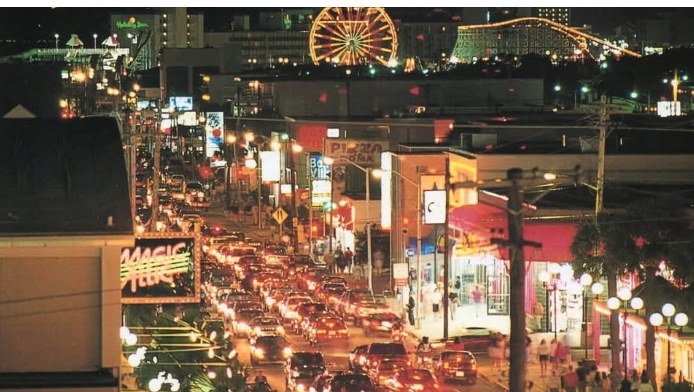
The Magic Attic: Myrtle Beach’s Crown Jewel
The Magic Attic wasn’t just a nightclub—it was an institution. Located on the famous strip, it became a rite of passage for anyone wanting to experience live music and a night they’d never forget. Its neon sign was a beacon, calling out to locals and tourists alike.
Inside, the dance floor was always alive. For many, the highlight of a summer night was climbing those stairs, walking into the pulsing lights, and losing yourself in the music. This was where bands came to prove themselves, where the crowd pressed close to the stage, and where memories that lasted a lifetime were made.
I still remember seeing Sawyer Brown there. At the time, they weren’t just a band—they were a phenomenon.
Sawyer Brown: From Star Search to Myrtle Beach
Sawyer Brown’s story is one of grit and determination. The group was formed in 1981 in Apopka, Florida, and in 1983, they became household names after winning the television competition show Star Search, hosted by Ed McMahon. They not only won the Vocal Group competition but also took home the grand prize of $100,000—a fortune in those days.
With their mix of country rock and high-energy stage presence, Sawyer Brown became known as the “Rolling Stones of Country Music.” Hits like “Step That Step” (their first number one), “Some Girls Do”, and “Thank God for You” solidified their place in the soundtrack of the 80s and 90s.
When they came through Myrtle Beach and played the Magic Attic, it was more than just a concert—it was an event. The crowd danced shoulder-to-shoulder, the floor thumped beneath our feet, and for a couple of hours, the whole world shrank down to that glowing, electric space above the boulevard.
Gen X Summers on the Boulevard
Walking down Ocean Boulevard in the 80s was like stepping into a carnival that never shut down. The sidewalks were crowded with kids holding giant stuffed animals won from the midway, teenagers showing off their new sunburns, and couples arm in arm with ice cream cones dripping down their hands.
The air was thick with the smell of cotton candy, pizza by the slice, and funnel cakes fried golden. Street performers competed with the calls of barkers at the arcades, and everywhere you looked was motion—bumper cars, tilt-a-whirls, and neon signs flickering against the night sky.
It was loud. It was chaotic. It was freedom.
For us Gen X kids, this was our playground. No cell phones, no TikTok, no instant uploads—just pure experience. Every night felt like the start of something unforgettable.
When It All Changed
Sadly, the Myrtle Beach we knew didn’t last forever. By the mid-2000s, the Pavilion amusement park closed down (2006), and with it went a huge piece of the city’s identity. The Magic Attic, along with many other iconic spots, eventually shut their doors as developers reshaped downtown into something shinier, more commercial, but less… magical.
The neon glow dimmed, and the sidewalks grew quieter. For many of us, it felt like losing a piece of childhood—a part of Myrtle Beach that could never truly be rebuilt.
Why It Still Matters
Looking back now, those nights on the boulevard weren’t just about fun—they were about community, culture, and the feeling of being alive in a world that hadn’t yet been digitized. The Magic Attic, Sawyer Brown, and the Pavilion weren’t just landmarks—they were touchstones of a generation that knew how to live in the moment.
Even though the strip has changed, the memories remain. And for those who were lucky enough to be there, walking those sidewalks in the 80s, hearing Sawyer Brown at the Magic Attic, and riding the Pavilion rides until midnight, there’s nothing quite like it.
References & Resources
- Sawyer Brown Official Website: https://sawyerbrown.com
- Star Search Archives – Classic TV: https://classic-tv.com
- Myrtle Beach Pavilion History: https://www.myrtlebeachonline.com
- Myrtle Beach Memories Facebook Groups & Historical Forums
Disclaimer
This blog is written for entertainment and historical reflection. Dates and details are based on publicly available sources and personal recollection. This is not an official historical record but a nostalgic retelling.
About the Author
Audrey Childers (A.L. Childers) is a Southern author, storyteller, and cultural historian who grew up in the Carolinas. Her work blends personal memories with historical research, bringing to life the moments and places that shaped generations. Audrey has written numerous books and blogs on history, culture, and personal transformation. You can explore more of her work at TheHypothyroidismChick.com and on Amazon under her author name, A.L. Childers.

