
By Audrey Childers
On July 6, 1944, a fire broke out under the big top of the Ringling Brothers Barnum & Bailey Circus in Hartford, Connecticut. In just 10 minutes, 167 lives were lost in one of America’s worst tragedies. Discover the story behind the circus, the fire, and the unanswered questions that still linger.


🎪 The Circus Arrives in Hartford
On a hot and humid July afternoon in 1944, thousands of excited families poured onto a field along Barbour Street in Hartford, Connecticut. The war in Europe was raging, and for many Americans, the circus was a brief, magical escape from a world at war.
The Ringling Brothers Barnum & Bailey Circus was known nationwide as “The Greatest Show on Earth.” People traveled from surrounding towns to see the sequined dancers, clowns with painted faces, trained animals, and jaw-dropping aerial acts. That day, between 6,000 and 8,000 spectators—many of them children—crammed beneath the massive 500-foot big top tent.
But beneath the glitter and excitement, this circus carried a chaotic underbelly that few outsiders ever saw.
🌍 The Rise of the American Traveling Circus
The story begins in 1871 with the vision of P.T. Barnum, later joined by James A. Bailey. Their goal was to bring a grand spectacle to the masses—taking exotic animals, daring performers, and elaborate acts across America’s growing railway system.
These traveling circuses were a logistical marvel. Crews of hundreds—many living a nomadic, difficult life—built temporary tent cities in each new town. Trains carried not only performers and animals but also entire kitchens, dressing tents, sleeping cars, and elaborate sideshows that promised wonders like “The Snake Girl” or “The World’s Smallest Man.”
Life on the road was harsh. Workers endured grueling travel schedules, unpredictable weather, dangerous rigging work, and the constant pressure to “keep the show going” no matter what. Yet, the circus thrived—drawing crowds by the thousands in towns large and small.
By the 1940s, Ringling Brothers Barnum & Bailey Circus stood at the top of this empire. Their arrival in a town was a major event, advertised with posters weeks in advance, promising thrills and a temporary escape from everyday life.
🚨 A Hot Day, a Packed Tent, and a Single Cigarette
On July 6, 1944, the show opened late. Many circus workers were overseas fighting in World War II, leaving the show short-staffed. A scheduled matinee the previous day had been canceled—a bad omen in circus culture—and as a result, the July 6 performance drew an even larger crowd than usual.
The show began normally. A French lion tamer wowed the crowd, followed by the famous high-wire troupe, The Great Wallendas. But just as the next act was set to begin, a shout ripped through the tent:
“The tent’s on fire!”
Near the men’s bathroom, someone had discarded a cigarette, sparking flames on the outside of the tent. Tragically, the tent’s canvas had been waterproofed with a highly flammable mixture of paraffin wax and gasoline, a common but deadly practice at the time. The fire leapt to the canvas and raced across the surface in seconds.
Inside, the circus band began playing “Stars and Stripes Forever”—a secret signal used to indicate a life-threatening emergency. Panic broke out almost immediately.
🔥 Ten Minutes of Terror
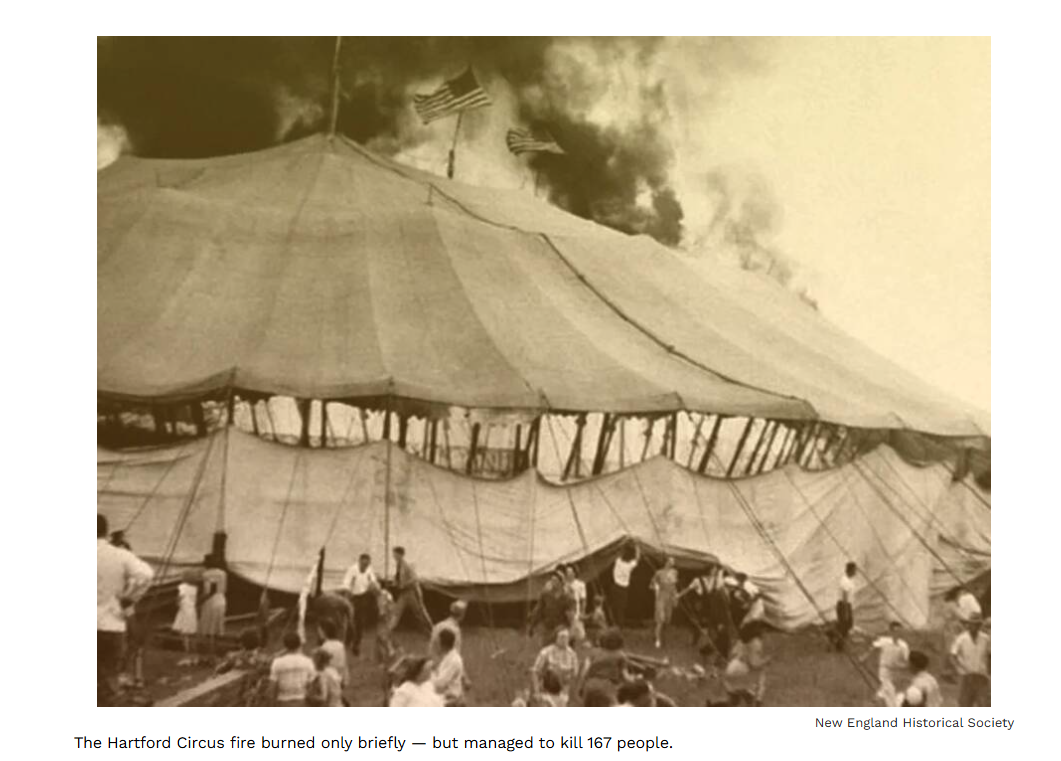
Flames shot 100 feet into the air. People scrambled toward exits, but many were blocked by narrow chutes and bottlenecks. Burning canvas fell from above, setting clothing and hair alight. Some slashed their way through the tent walls to escape. Others were trampled in the chaos.
The entire fire lasted just 10 minutes.
When it was over, the tent had collapsed into a smoldering ruin. 167 people were dead—and heartbreakingly, at least 100 of them were children. Hundreds more were injured, burned, or psychologically scarred for life.
Among the attendees that day was Edward J. Hickey, Connecticut’s state police commissioner and fire marshal, who witnessed the horror firsthand. He later recalled:
“I saw people piled alongside the chute cage, flaming and burning, shrieking and hollering.”
🕵️ Accident or Arson?
Initially, investigators blamed the disaster on a careless cigarette and the circus’s poor fire preparedness. Fire extinguishers were locked away, trucks were parked too far to help, and the Hartford Fire Department had not even been notified of the circus’s arrival.
Five circus employees were charged with manslaughter. The circus agreed to pay $4 million in damages to victims and families—an enormous sum at the time.
But in 1950, a new twist emerged. An Ohio man named Robert Segee, a former circus worker and confessed serial arsonist, claimed he had started the Hartford fire. He also admitted to setting blazes in Portland, Maine, and Providence, Rhode Island—the same towns the circus had passed through before Hartford.
Though his confession was inconsistent and never fully proven, it reignited suspicions that the tragedy may not have been an accident after all.
🏁 The Aftermath and Legacy
The Hartford Circus Fire marked the beginning of the end for the big-top era. In response to the tragedy, fire safety laws changed dramatically:
- Paraffin-coated tents were banned.
- Flame-retardant materials became mandatory.
- Exits, extinguishers, and emergency protocols were standardized.
By the 1950s, circuses began moving their shows into permanent arenas rather than canvas tents. The romantic—but perilous—age of the traveling circus was fading.
The site of the fire remains a solemn place in Hartford today. A memorial honors the lives lost, reminding future generations of the price of spectacle when safety is overlooked.
✍️ Disclaimer
This article is a historical account written for educational and informational purposes. It draws from historical archives, eyewitness testimony, and public records. Some aspects—such as the exact cause of the fire—remain debated to this day.
📚 References & Resources
- Connecticut State Library Archives
- University of Connecticut Digital Collections
- Hartford Courant historical reporting, July 1944
- National Fire Protection Association (NFPA) Historical Reports
- CT Insider historical investigations
- HISTORY.com archives on the Hartford Circus Fire
🖋️ About the Author – Audrey Childers
Audrey Childers is a passionate historian, journalist, and storyteller who brings forgotten moments of history vividly back to life. With a love for uncovering the hidden truths behind iconic events, Audrey’s work blends meticulous research with human storytelling to captivate modern readers. She writes across multiple genres—history, socio-political exposés, health, and personal memoir—aiming to both enlighten and inspire.

