Tag Archives: #mindfulness

Why We Remember Embarrassing Moments From 12 Years Ago While Trying to Sleep


Why your brain replays embarrassing memories at 2 a.m. like a personal horror film — and what science (and Southern logic) says about it. A hilarious, relatable blog by author A.L. Childers.


🌙 Why We Remember Embarrassing Moments From 12 Years Ago While Trying to Sleep

or as I call it: “My Brain Runs a Cringe Marathon While I’m Just Trying to Breathe.”

Last night, as I was settling into bed — you know, trying to relax, regulate my nervous system, maybe pretend I have my life together — my brain whispered:

“Hey… remember that time in 7th grade when you waved back at someone who wasn’t waving at you?”

Excuse me?
WHY ARE WE DOING THIS RIGHT NOW?

It’s 2:13 a.m.
I’m horizontal.
I have melatonin in my bloodstream.
This is a hostile attack.

But of course, my brain keeps going:

Remember that time—

  • you tripped in Walmart?
  • your stomach growled during a prayer?
  • you said “You too” to a waiter who told you to enjoy your meal?
  • you called your teacher “Mom”?
  • or that one time at church when you blessed the wrong baby?

WHY. NOW.


🧠 **Let’s break down the science.

(Yes, science — but we’re doing it the A.L. Childers way.)**

There are actual psychological explanations for this:

⭐ 1. Your brain thinks embarrassment = danger

The amygdala (the little anxiety gremlin in your brain) doesn’t know the difference between:

  • “I almost got eaten by a bear”
    and
  • “I pronounced ‘acai’ wrong in public.”

To your brain?
Same thing.

Protection mode activated.

⭐ 2. You finally slowed down… so your brain finally speeds up

All day, you’re busy.
Work. Kids. Emails. Drama. Surviving America.

But once you lie down?

Your brain goes:

“Ah yes… time to revisit every social mistake since 2004.”

It’s like your mind waits until you’re vulnerable and can’t fight back.

⭐ 3. Your brain LOVES unresolved emotional files

Embarrassing moments are like open tabs on a computer you forgot to close.

When you try to sleep, your brain is like:

“Before we shut down… let’s run diagnostics on the most CRINGE thing you ever did.”

And like a loyal trauma archivist, it pulls receipts.


🤡 But here’s MY theory (Southern Science™):

Embarrassing memories return at night because:

  • ghosts are bored
  • our ancestors need entertainment
  • the universe is humbling us
  • our brains are run by petty interns
  • or God is running reruns for fun

Because truly, some of these memories pop up like:

“Hi, it’s me.
From 15 years ago.
Remember when you said ‘You too’ to the Uber driver who told you to have a safe trip?”

NO I DO NOT AND I DO NOT CLAIM THAT VERSION OF ME.


🎬 **A Cinematic Reenactment:

Your brain at 2 a.m.**

Interior. Bedroom. Moonlight. Soft breathing.

Your brain:
“Roll the tape.”

You:
“NO.”

Your brain:
“But it’s the part where you asked a pregnant woman when she was due… and she wasn’t pregnant.”

You:
“DELETE IT.”

Your brain:
“We can’t. It’s in 4K.”


🧩 Eyewitness Testimonies (Absolutely Real, Do Not Question Them)

Tiffany, age 32:
“My brain showed me a memory from 2008 so vividly I had to apologize out loud. To no one.”

Marcus, age 40:
“I remembered a moment so embarrassing I sat up and turned on the light and said ‘NOT TODAY.’”

Anonymous Southern Woman:
“I remembered a church memory so bad I had to rebuke it.”

Same, ma’am. Same.


⚠️ Disclaimer (Because Some of Y’all Need Calmness & Clarity)

This blog is:

  • humor
  • truth
  • trauma-adjacent comedy
  • psychologically informed
  • spiritually accurate (in the Southern sense)
  • legally safe
  • and meant to remind you
    that EVERYONE relives cringe at night.

You’re human.
Your brain is dramatic.
That’s all.


🖊️ About the Author

I’m A.L. Childers — storyteller, overthinker, Carolina-raised human disaster, and multi-genre author of more than 200 books ranging from dark history to empowerment to humor to corruption exposés.

If there is a strange, unexplainable, emotionally-charged human experience…
I will write it.

I peel back the layers of the mind, society, and the world with a mix of:

  • humor
  • honesty
  • archival research
  • and Southern “I’ve seen some stuff” energy

If you’ve ever laughed at your own pain…
overthought your entire life at 1 a.m.…
or apologized to yourself for something you did in 2009…

Welcome to my people.


📚 References & Resources

(Real science + sprinkled humor)

• Dr. Robyn Bluhm — The Psychology of Embarrassment
• UC Berkeley Sleep Lab — Why intrusive thoughts spike at bedtime
• National Institute of Mental Health — Amygdala responses to social threat
• “Intrusive Memories & Overthinking,” Journal of Cognitive Neuroscience
• My own brain, which will not shut up
• The ghosts who whisper “remember that time?”

From Mixtapes to TikTok: Why Time Feels So Different Now

“Time is money.” We’ve all heard it, but in today’s world of endless scrolling, likes, and algorithms, it feels truer than ever. Social media has become a thief of hours, and the saddest part? Most of us don’t even notice it happening until the day is gone.

Back in the 80’s, time was spent differently. We weren’t chasing notifications—we were chasing songs on the radio, waiting to hit “record” on our cassette decks at just the right moment. We weren’t refreshing feeds—we were riding bikes, hanging at the mall, or making mixtapes for friends.

The 80’s weren’t perfect, but they gave us something we’ve lost today: space. Space to be bored, to imagine, to create, and to actually live in the moment instead of performing it for a screen. Today, every second feels monetized. Scrolls, clicks, swipes—it’s all designed to keep us busy but not fulfilled.

And that’s not an accident. In my books, I’ve written about how systems—whether political, economic, or digital—are built to control us. Books like Silent Chains: Breaking Free from Conformity and Injustice and The Hidden Empire: A Journey Through Millennia of Oligarchic Rule dig into how power has always found ways to steal our time, our attention, and our freedom. Social media is just the latest disguise.

Maybe that’s why we feel so burnt out. Because our hours have been turned into someone else’s profit.

So here’s the challenge: reclaim your time. Spend it like we did in the 80’s—on music, creativity, connection, and things that actually matter. Because once time is gone, no app can give it back.


🎤 About the Author

A.L. Childers is a multi-genre author and creator who blends nostalgia, truth, and modern insight into stories that matter. Her books—spanning health, history, and hidden truths—expose how systems of control shape our lives, while offering a path toward freedom and authenticity. From Silent Chains to The Hidden Empire, Childers reminds readers that reclaiming time and truth is the first step toward reclaiming ourselves.


⚠️ Disclaimer

This blog reflects personal perspective and commentary. It is not an endorsement or critique of any specific social media platform.

💡 Attention Is the New Currency: Why Not All Money Is Good Money

We’ve all heard the saying, “time is money.” But in the 21st century, there’s a new truth: attention is money. Every second of focus we give to a screen, product, or idea translates into revenue for someone. Tech companies, advertisers, politicians, and even influencers understand this—your gaze is their paycheck.

But here’s the catch: not all attention leads to good outcomes, and not all money made from attention is clean money. Some profits are built on manipulation, exploitation, or even the erosion of our mental and physical health. Understanding the attention economy is more than media literacy—it’s a survival skill.


The Historical Roots of Attention as Currency

Ancient Civilizations: The Power of Spectacle

  • In ancient Greece, public debates and plays were carefully staged to capture the audience’s attention. Whoever commanded the crowd often held influence in politics and society.
  • Roman gladiatorial games served as mass distractions—“bread and circuses”—designed to pacify citizens and keep them from questioning authority. Attention meant control.

The Medieval World: Religion and Authority

  • Cathedrals were built with towering spires and stained glass not only for devotion but also to capture awe. These visual spectacles pulled attention toward the Church, reinforcing spiritual and political power.

The Printing Press to Yellow Journalism

  • Johannes Gutenberg’s printing press (1450s) created a new market for attention—books, pamphlets, and newspapers.
  • By the late 1800s, William Randolph Hearst and Joseph Pulitzer popularized yellow journalism, using sensational headlines to boost sales. The principle? Grab attention first, worry about truth later.

The Broadcast Century

  • With the rise of radio and television, attention became measurable in ratings. The more eyeballs glued to the screen, the higher the advertising revenue. Commercial jingles, celebrity endorsements, and primetime slots were all methods to monopolize attention.

The Digital Age: Selling Focus by the Second

Today, we live in a world where algorithms have replaced gladiators. Instead of stadiums, we gather in digital arenas—TikTok, YouTube, Instagram, and Netflix—where our attention is sliced into data points and sold to advertisers.

  • Social Media Algorithms: Platforms are engineered to keep you scrolling. Infinite feeds, push notifications, and “likes” are psychological hooks.
  • Surveillance Capitalism: As Shoshana Zuboff explains in The Age of Surveillance Capitalism, companies don’t just sell ads—they harvest your behavior to predict and manipulate future choices.
  • The Rise of Influencers: Everyday people turn themselves into brands, trading authenticity for clicks. Some succeed ethically, others promote harmful products just to secure sponsorships.

The global attention economy is now worth trillions of dollars. Yet, while companies profit, individuals often pay with stress, distraction, and diminished well-being.


Why All Money Isn’t Good Money

Exploitation Through Fear and Shock

  • Media often prioritizes shocking, divisive, or fear-driven content because it guarantees clicks.
  • Fear sells fast—but it corrodes trust, inflames division, and feeds anxiety.

Addiction by Design

  • From casino slot machines to Instagram reels, the psychology of addiction is built into many platforms.
  • Dopamine hits from “likes” and notifications are no accident—they are monetized vulnerabilities.

Profit at the Expense of Health

  • Sugary drinks, processed foods, cigarettes, and even pharmaceuticals have been marketed aggressively—earning billions despite proven health risks.
  • The result? Corporations thrive, while individuals suffer long-term consequences.

Misinformation as a Business Model

  • Fake news, conspiracy-driven content, and clickbait websites often exist for one reason: to generate ad revenue.
  • Truth becomes secondary when profit depends on attention, not accuracy.

The Psychology of Attention

  • Scarcity Principle: Attention is limited. You can’t give it to everything, which is why it’s so valuable.
  • Cognitive Load: Our brains can only process so much. Overloading with information leads to decision fatigue.
  • Attention Hijacking: Marketers and platforms exploit psychological triggers—fear, novelty, outrage, and even cuteness—to redirect your focus where they want it.

How to Protect Your Attention (and Your Soul)

  1. Audit Your Consumption: Ask yourself—who profits from what I’m watching, reading, or buying?
  2. Digital Boundaries: Turn off non-essential notifications and schedule screen-free hours.
  3. Value-Based Attention: Invest your time in media, people, and causes aligned with your values.
  4. Mindful Spending: Question whether every financial opportunity or purchase aligns with integrity.

Remember: attention is power. Spend it wisely.


Resources and References

  • Books:
    • Tim Wu, The Attention Merchants: The Epic Scramble to Get Inside Our Heads
    • Shoshana Zuboff, The Age of Surveillance Capitalism
    • Johann Hari, Stolen Focus: Why You Can’t Pay Attention—and How to Think Deeply Again
  • Studies:
    • American Psychological Association research on attention span and mental health.
    • Pew Research Center reports on misinformation and media trust.
  • Articles:
    • The Guardian: “Your Attention Didn’t Collapse. It Was Stolen.”
    • Harvard Business Review: “Why Attention Is the Real Currency in the Digital Age.”

Takeaway

Attention has always been a form of power. What has changed is the scale and sophistication with which it’s being harvested. Money flows where attention goes—but when that money is made through manipulation, exploitation, or harm, it carries a heavy cost.

Not all money is good money. Protecting your attention is protecting your freedom.


Disclaimer

This blog is based on historical research, documented sources, and the author’s personal interpretation. It is intended for educational and informational purposes only. Readers are encouraged to do their own research and draw independent conclusions.


About the Author

A.L. Childers is a researcher, blogger, and author of multiple books that dive into history, psychology, and cultural critique. She has written extensively on how hidden forces—whether political, corporate, or spiritual—shape our daily lives. Her mission is to empower readers with knowledge, awareness, and the tools to live more consciously.


👩‍👧 Quick Parenting Hacks for Neurodivergent Families

Simple, everyday tools to bring more calm into your home


🧩 1. The 3–2–1 Reset

When emotions run high, pause and try this together:

  • 3 deep breaths
  • 2 things you can see and name
  • 1 thing you are grateful for
    This helps reset the nervous system and shift focus.

🧩 2. Sensory-Friendly Morning Routine

  • Lay out clothes the night before
  • Use soft lighting instead of bright overheads
  • Keep breakfast predictable (rotate 2–3 favorite meals)
    Reduces overstimulation first thing in the day.

🧩 3. The “Calm Corner”

Create a space in your home with:

  • Noise-cancelling headphones
  • A weighted blanket
  • A basket of fidgets or sensory toys
    This gives both kids and parents a safe space to regulate before things escalate.

🧩 4. Micro-Breaks for Parents

  • 5 minutes with headphones and calming music
  • A quick walk outside
  • A simple grounding mantra: “I am safe. I can reset. This moment will pass.”
    Your nervous system sets the tone — caring for yourself helps your kids too.

🧩 5. The “Visual To-Do” List

Use whiteboards or sticky notes with simple icons/words for daily tasks. Neurodivergent kids (and parents!) often thrive with visual reminders over verbal instructions.


💜 From My Family to Yours

As a mom and grandmother who has walked this path of undiagnosed neurodivergence, I know the feelings of overwhelm, shame, and exhaustion. These quick hacks aren’t about being perfect — they’re about making life just a little easier and more connected each day.


📘 Want More Support?

Discover tools, research, and real-life stories in my book:

Silent Struggles: Navigating Parenthood with Undiagnosed Neurodivergence
by A.L. Childers — available on Amazon.

👉 Search for Silent Struggles by A.L. Childers on Amazon


⚖️ Disclaimer

I am not a medical professional. These parenting hacks are based on lived experience, research, and practical application. Always consult with a licensed professional for medical or therapeutic advice specific to your family’s needs.


💫 Dance, Laugh, and Embrace the Magic of the Chaos

Life isn’t neat. It doesn’t line up in perfect rows, it doesn’t follow your carefully written planner, and it rarely asks for permission before tossing in a curveball. But what if the very chaos we spend so much energy resisting is actually where the magic lives?

Sometimes the secret isn’t in controlling the storm—it’s in learning to dance in the middle of it, laugh at the mess, and embrace the magic of the chaos.


🕊️ Why Chaos Feels Overwhelming

Humans crave order. We want ducks in a row, schedules in place, and predictability in our days. But history, mythology, and even nature remind us: chaos is natural.

  • The cosmos itself was born from chaos—the Greeks called it Khaos, the great void before creation.
  • Crows and trickster figures in folklore remind us that disorder often leads to wisdom.
  • Life’s turning points—falling in love, changing careers, starting over—usually begin with a little chaos.

What feels messy at first is often just the beginning of transformation.


💃 Dance Through the Storm

When life spins out of control, you have two choices: freeze in fear or move with it. Dancing through chaos isn’t about ignoring problems—it’s about keeping your rhythm while the world shifts.

  • Dance in the kitchen while the laundry piles up.
  • Sing in the car when traffic has you stuck.
  • Find joy in the moment even if the bigger picture isn’t clear yet.

😂 Laugh at the Mess

Laughter is one of the greatest survival tools. Science shows it lowers stress, strengthens immunity, and bonds us to others. Spiritually, it shifts heavy energy into light.

Next time life feels overwhelming, ask yourself: “Will this be funny in five years?” If the answer is yes, go ahead and laugh now.


✨ The Magic of Embracing Chaos

When you stop resisting, chaos becomes magic:

  • It pushes you to grow in ways order never could.
  • It breaks illusions and shows you what really matters.
  • It teaches flexibility—a skill more valuable than perfection.

Think of it this way: chaos is life’s way of shaking the snow globe so you can see a new scene more clearly.


🌙 Rituals to Embrace the Magic

  • Moonlight Reset: Step outside, breathe deeply, and release control under the night sky.
  • Journaling Chaos: Write down everything messy in your life, then flip the page and write what it’s teaching you.
  • Dance Breaks: Set a timer once a day and move your body freely—no rules, no rhythm, just joy.

SEO Keywords: rituals for chaos, how to embrace life’s chaos, spiritual meaning of chaos


📚 About the Author

A.L. Childers writes about the intersection of history, spirituality, and everyday life with warmth and humor. Her books include:

  • Archons: Unveiling the Parasitic Entities Shaping Human Thoughts
  • The Archonic Influence on Human Perception and Their Role in Human History
  • The Hidden Empire: A Journey Through Millennia of Oligarchic Rule
  • Roots to Health
  • Beyond Words: The Science of Seduction and Connection

She believes that within every bit of chaos is a hidden lesson—and sometimes, even a reason to laugh.


⚖️ Disclaimer

This blog is for inspiration and entertainment only. It offers reflections on embracing life’s unpredictability but is not a substitute for professional medical, mental health, or spiritual guidance.


🌟 Final Thought

Life isn’t meant to be tidy. It’s a messy, glorious, unpredictable ride. So instead of chasing perfect order, let yourself:

Dance when it’s hard. Laugh when it’s messy. And embrace the magic hidden inside the chaos.

Don’t Take the Bait: Protecting Your Peace in the Age of Online Outrage

By A.L. Childers

In a world where your attention is currency, rage has become a profitable business.

You’ve seen it: the outrageous headlines, the offensive comments, the divisive content that seems designed to ruin your mood before you’ve had your morning coffee. It’s not an accident. It’s called rage bait—and it’s everywhere.


What Is Rage Baiting?

Rage baiting is a form of digital manipulation where creators post inflammatory, shocking, or controversial content to provoke anger and engagement. It thrives on emotional reactivity. The more you comment, share, or argue, the more the algorithm rewards the post.

According to MIT Technology Review, emotional responses—especially anger—are more likely to go viral than calm, rational content. A 2017 study from Yale University also found that social media users tend to mimic the outrage they see online, escalating hostility in digital spaces.

Rage baiting didn’t just happen; it was designed. Social media platforms like Facebook, Twitter (X), and TikTok rely on engagement metrics to sell ads and keep users scrolling. The more time you spend reacting, the more money they make.


How Rage Bait Works

Rage bait follows a predictable formula:

  • Step 1: Post something shocking, misleading, or controversial.
    Example: “You’re not a real parent if you don’t spank your kids.”
  • Step 2: Trigger people emotionally.
    Use topics like politics, religion, parenting, race, gender roles, or celebrity drama.
  • Step 3: Let the audience do the work.
    The more people argue, the more the post gets pushed to new feeds.

Rage baiters don’t always believe what they post. Often, it’s pure manipulation to gain clicks, followers, and revenue. They trade in your peace for their profit.


Why You Should Protect Your Spirit

Let’s be real: the devil is busy, and he doesn’t always show up with horns. Sometimes, he shows up in your feed—disguised as drama, division, and distraction.

If you’re constantly being pulled into online fights, your peace suffers. Your energy goes toward defending yourself instead of developing yourself. What begins as “just one comment” turns into hours of emotional exhaustion and spiritual depletion.

Protect your spirit like your life depends on it—because in many ways, it does.


How to Avoid Rage Baiting

Here are 7 powerful ways to guard your heart and your attention:

  1. Pause Before You React
    Ask yourself: Is this post designed to inform or to provoke?
  2. Limit Time on Trigger-heavy Platforms
    Apps like X (formerly Twitter) and TikTok are built for outrage. Curate your feed or take breaks.
  3. Unfollow or Mute Accounts That Drain You
    Protect your peace by pruning your digital space.
  4. Report Obvious Rage Baiting
    Social media companies allow you to flag abusive or manipulative content.
  5. Respond with Grace—Or Not at All
    Not every comment deserves a reply. Sometimes silence is strength.
  6. Seek Out Uplifting Content
    Follow creators who nourish your mind, faith, and well-being.
  7. Set Boundaries with the Algorithm
    The more you engage with outrage, the more it shows up. Don’t feed the beast.

Final Thoughts

You were not created to live in constant combat with strangers on the internet. You were created for connection, purpose, and peace. Rage baiting may be loud, but peace is powerful. Don’t let evil hijack your energy.

Every day, you have a choice: react in rage or respond with wisdom.


Disclaimer

This article is for informational and inspirational purposes only. The views expressed are those of the author and are not intended as psychological or legal advice. Please seek professional support if online abuse or digital burnout is affecting your mental health.


About the Author

A.L. Childers is a passionate truth-teller, bestselling author, and advocate for emotional wellness in a world full of noise. With hundreds of published works across genres, she writes to awaken hearts, expose manipulation, and remind readers that peace is not a luxury—it’s a right. Follow her work to reclaim your story and your sanity.

The Real Luxuries in Life: Rediscovering What Truly Matters

In a world that glorifies hustle, speed, and accumulation, we often overlook the quiet treasures that make life deeply meaningful. We chase titles, luxury brands, and curated lifestyles—yet the richest among us may still yearn for things that money can’t buy.

The real luxuries in life aren’t found in shopping bags or exotic zip codes. They’re found in:

  • Time — uninterrupted, unscheduled moments to just be.
  • Health — a functioning body and a peaceful mind.
  • A quiet mind — the kind that doesn’t race to the next task.
  • Slow mornings — sipping coffee without urgency.
  • The ability to travel — not just in miles, but in freedom.
  • Rest without guilt — a true rarity in a society driven by performance.
  • A good night’s sleep — not interrupted by worry or deadlines.
  • Calm and “boring” days — which are, in truth, incredibly sacred.
  • Meaningful conversations — where we feel heard, seen, and understood.
  • Home-cooked meals — made with love, not convenience.
  • People you love — and more importantly, people who love you back.

As I reflect on these simple, powerful luxuries, I’m reminded of the chapters in my own life where I didn’t realize how rich I truly was. Sometimes, the most meaningful blessings come disguised as ordinary moments.

I invite you to slow down. To sit with your morning a little longer. To call someone just to say hello. To listen. To breathe. These are the luxuries that don’t depreciate over time—they deepen.


About the Author
A.L. Childers is an author, mother, and seeker of truth who writes with heart, grit, and a dash of rebellion. From exposing hidden histories to guiding others through healing and personal transformation, her work spans both nonfiction awakenings and emotional storytelling. She believes that life’s real treasures are not stored in banks, but in memories, health, and human connection.


Explore Her Books
Looking for stories and insights that can shift your perspective and nourish your soul?

📚 The Hidden Empire: A Journey Through Millennia of Oligarchic Rule – Uncover the truth they don’t teach in school.
📚 The Quantum Leap: Habits That Reshape Your Reality – A guide to rewiring your life with intention.
📚 Pawsitively Nourished – A heartfelt book for dog lovers, packed with healing recipes and love.

Find them on Amazon by searching “A.L. Childers” or visit TheHypothyroidismChick.com to join the journey.


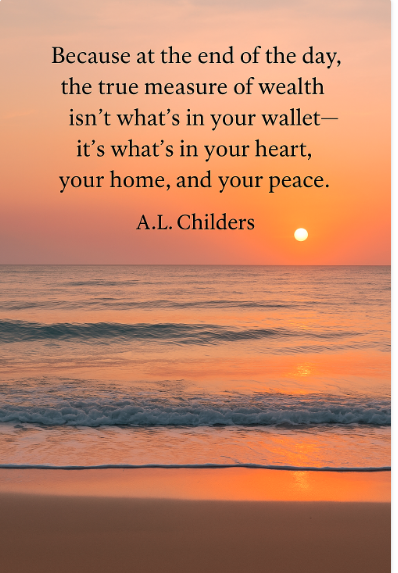
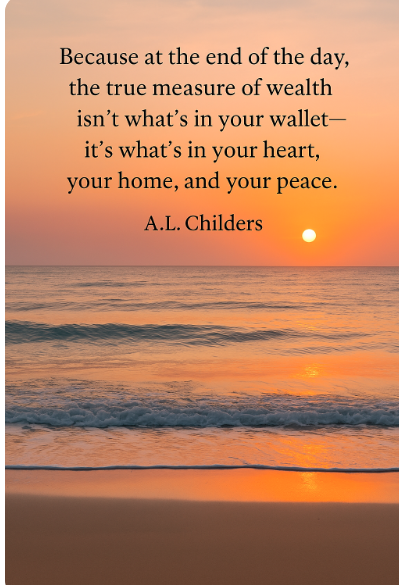
Because at the end of the day, the true measure of wealth isn’t what’s in your wallet—it’s what’s in your heart, your home, and your peace.

Disclaimer:
The thoughts and reflections shared in this blog are for inspirational and educational purposes only. They are not intended to substitute professional advice in areas such as mental health, finance, or wellness. Every individual’s journey is unique, and what resonates with one person may not resonate with another. Please consult appropriate professionals when making decisions that impact your well-being. All content is the original work of A.L. Childers and may not be copied or reproduced without written permission.

🍂 The Craving for Autumn: Why Fall Awakens the Soul

By A.L. Childers

“I crave the sight of colorful leaves.
Magical pumpkins…
and cinnamon-scented breeze.”

The October Poet

There’s something about autumn that pulls at us. It’s not just the pumpkin spice or the Instagram-worthy foliage—it’s something deeper, something almost ancestral.

Fall is the season that whispers, “Slow down. Breathe. Feel.”

🍁 Why Do We Crave Autumn So Deeply?

1. It’s Nature’s Last Dance Before the Stillness

The vibrant colors of the trees aren’t just beautiful—they’re nature’s farewell performance before winter’s hush. In psychology, seasonal shifts trigger emotional shifts, and autumn often brings introspection, nostalgia, and a longing to reconnect—with ourselves and others.

2. We’re Wired to Nest

The cooler air stirs up an instinctual desire to cozy up, gather loved ones, light candles, and bake. It’s why cinnamon, nutmeg, and clove feel like comfort. Studies show that scent is the strongest sense tied to memory—and cinnamon, in particular, has been linked to feelings of safety and happiness.

3. Pumpkins and Leaves Spark Creativity

Whether you’re carving jack-o’-lanterns or watching leaves dance in the wind, autumn ignites the imagination. The return of crisp air and warm drinks is a cue to shift from survival mode to soulful mode.

4. It Signals Time for Rebirth

Oddly enough, while things are dying in nature, many people experience fall as a beginning. A new school year, new habits, a return to routine—all signal opportunity for change.


🧡 What This Season Teaches Us

Autumn tells us it’s okay to let go.
It’s okay to shed the dead things.
It’s okay to rest.

That craving you feel for fall?
It’s your soul saying, “I’m ready for stillness. For magic. For a moment that smells like cinnamon and sounds like crunchy leaves.”


✍️ About the Author

A.L. Childers is a multi-genre Southern writer known for weaving soulful truths into everyday stories. Her voice is part warmth, part wit, and always honest. Whether she’s writing about health, history, or heartbreak, A.L. believes in the power of words to ground, uplift, and connect us. Explore more at TheHypothyroidismChick.com or discover her books at amazon.com/author/alchilders.


🛑 Disclaimer

This blog is for inspirational and informational purposes only. It reflects the opinions and personal experiences of the author and is not intended to substitute medical or psychological advice. For mental health support, please consult a licensed professional.


🍂 Takeaway Thought

So go ahead—crave the color. Light the candle. Let the cinnamon-scented breeze wash over you.

You’re not being sentimental.
You’re being human.
And fall… is the most human season of all.

“Anxiety Is Loud—Even in Silence”

Understanding the Battle Within When Your Mind Won’t Quiet Down
By A.L. Childers

If you’ve never lived with anxiety, you won’t understand me when I say this:
I am my own worst enemy.

And that isn’t just a cute Instagram quote I throw around when things feel heavy—it’s a reality that lives in my bones.

My brain doesn’t know what “off” means. It churns like an old washing machine, stuck on the spin cycle, sloshing the same fears and “what ifs” over and over again until everything is soaked in overthinking.

Sometimes, I even annoy myself.
Ever get mad at your own thoughts?
Yeah. That’s anxiety.

It’s walking into a room and feeling like everyone’s eyes are on you—when nobody’s even noticed you walked in.
It’s getting an attitude over an event that hasn’t even happened yet.
It’s crawling back into your shell until it feels “safe” to be seen.

Anxiety is:

  • Believing everyone will eventually hurt you
  • Feeling like your best will never be good enough
  • Doubting your own motives, your actions, your voice—every step of the way

And the cruelest part?
It’s not even other people.
It’s you, battling yourself.


🧘🏽‍♀️ 5 Quick Ways to Calm the Storm

Here’s one thing anxiety hates: presence.
When you’re truly in the now, anxiety has no room to breathe.

Try this simple but powerful 5-step grounding tool the next time your thoughts are spiraling:

🌿 1. See

Look around and name 5 things you can see.
A tree, your shoes, a crack in the wall, a lamp—anything. It brings you out of your mind and into the room.

🖐️ 2. Touch

Find 4 things you can physically feel.
The fabric of your shirt, the floor under your feet, the chair beneath you. Focus on sensation.

👂 3. Hear

Notice 3 distinct sounds.
It might be a ticking clock, traffic, your own breath, or even a bird outside. Let your ears do the grounding.

👃 4. Smell

Name 2 things you can smell.
Even if you don’t smell anything right away, breathe in and try. You might notice your shampoo, fresh air, or coffee nearby.

👅 5. Taste

Acknowledge 1 thing you can taste.
It could be gum, toothpaste, or just the air. Take a sip of water or bite of something small if needed.

💬 This is called the “5-4-3-2-1” technique. It works like a reset button for your nervous system—and it’s completely free.

💡 And can I tell you a little secret?

I’ve had moments where even a Halls cough drop pulled me out of a spiral.
Yep. The menthol hits, your focus shifts, and suddenly your brain gets the memo: We’re still here. We’re okay.
Never underestimate the grounding power of something small—a mint, a breeze, a prayer, or even a Halls.


💭 What I’ve Learned Along the Way:

  1. You’re not broken—you’re human.
    You don’t need fixing—you need compassion and tools.
  2. Your anxiety is trying to protect you.
    It’s just overdoing its job. You’re allowed to tell it, “Thank you, but I’ve got this.”
  3. You are not your thoughts.
    You’re the observer of them, not the prisoner to them.

✍️ Author Notes from A.L. Childers

I didn’t write this to complain—I wrote it to connect.
To say out loud what so many of us whisper in silence.
If anxiety has ever made you feel broken, please hear this: you are not broken.
You are sensitive, intuitive, and strong enough to face battles no one sees.

This blog is for every woman lying awake at 2 a.m.
Every man second-guessing a sentence he said two days ago.
Every teen hiding tears because they think they’re “just dramatic.”
You are not alone. And you are not your anxiety. 💛


🛑 Disclaimer

This blog is based on personal experience and is not intended to replace medical advice. If you’re struggling with anxiety or mental health challenges, please contact a licensed mental health professional. You matter, and support is out there.


📚 Resources


🔗 About the Author

A.L. Childers is a Gen X storyteller with a heart for healing, humor, and hard truths. She writes from the front lines of life—with freckles, faith, and a whole lot of fire. Explore her mental wellness blogs and holistic health books at TheHypothyroidismChick.com, and shop her titles on Amazon at amazon.com/author/alchilders.

Your free printable PDF is ready!

📄 Download here:
Grounding_Pocket_Guide_by_AL_Childers.pdf

Why I Avoid Drama: It’s Me, Not You (Seriously)

Let’s get one thing straight right off the bat: I avoid drama not because I’m scared of you—but because I’m deeply, respectfully, and wholeheartedly scared of me.

Now, before you clutch your pearls, let me explain.

You see, some people are naturally calm under pressure. They meditate. They journal. They light a sage bundle and whisper affirmations into the void. Me? I’ve got a different system—one that involves recognizing the red flags before I turn into a full-blown hurricane with a driver’s license.

There’s a phrase I’ve lovingly coined: “zero to prison.” And no, it’s not a joke I take lightly. It’s just that I know myself. I’ve spent years learning how to self-regulate, breathe through conflict, and walk away when the heat rises. Not because I can’t clap back, but because I know that if I do… well, someone’s going to need bail money. And I like my weekends free, thank you very much.

The Real Reason I Keep the Peace

Here’s the truth no one tells you: choosing peace is not weakness—it’s self-awareness. It’s knowing that your tongue is a sword and your temper is nuclear. It’s realizing that not every battle is worth the energy, especially when you’ve worked so hard to heal, to grow, and to protect the calm you fought like hell to earn.

I’ve been through enough chaos in my life to know I don’t want to be the source of it anymore. I’d rather light a candle than light someone up (verbally, of course). I’d rather set boundaries than set the record straight with a scream. Because that old version of me? She’s still in there. And she can still throw down if needed—but these days, she prefers throw pillows and herbal tea.

What Drama Really Costs

Drama is expensive. It costs you your peace, your sleep, and sometimes your dignity. And when you’ve finally gotten your mind, body, and spirit into alignment, you realize just how precious peace really is. It’s not that I won’t defend myself—oh, I will. But I now ask myself, “Is this worth stepping out of character for?” And 9.5 times out of 10, the answer is nah.

A Spell of Self-Control

For anyone out there who feels this in their soul, here’s a little mantra:

“I choose calm not because I can’t raise hell, but because I’d rather raise standards.”

So to the ones who think silence means weakness, or that avoiding drama means you “won”—bless your heart. I’m not running scared. I’m just protecting you from meeting the me I’ve buried under years of growth and therapy.


Closing Thoughts
Let’s normalize walking away, setting boundaries, and sipping tea instead of spilling it. Let’s be the kind of women who know their power and use it wisely. And if you ever catch me in the middle of a storm, know this: I tried really hard to avoid it. 😌

Until next time, stay calm, stay grounded, and remember—sometimes peace is the real flex.