Tag Archives: pfas

A Tale of Thyroid Trouble, Poisoned Pints, and the Search for a Safer Sip

(by A.L. Childers)

There are moments in a woman’s life when her body stops behaving like a quiet tenant and becomes something more — a historian, a whistleblower, a furious little archivist cataloguing every harm she swallowed in silence. Mine did exactly that on a night that felt older than the century I lived in. The fog outside curled around the windows like a living thing, and the lamplight flickered as though it guarded secrets.

I had a cold beer in my hand.
A harmless indulgence.
Or so I thought.

The first swallow slid down easy, but the comfort ended there. A tightness in my throat — sudden, sharp. A heat under my skin. My pulse tapping out warnings I had been ignoring for years. You learn to recognize these things when your thyroid has been dragging itself through battle after battle, begging for help and getting none.

It felt as though a tired clerk inside my neck — an overworked little steward of metabolism and hormones — threw down its quill and shouted, “Enough!”

And that night, I finally listened.

I set the pint down and stared at it like a traitor. It wasn’t the drink itself that frightened me — it was the realization that my body had been sending quiet warnings for years. Weight gain. Swelling. Hair falling out. Exhaustion like a winter storm. And yet here I was, making room for one more thing it could not bear.

Later, unable to sleep, I began my search — not through modern neon-lit convenience, but the way any woman would if she found herself in an old world: hunched over a desk, lamp light flickering, reading through studies the way one might read confessions.

And the truth revealed itself with brutal clarity:

Beer was no longer beer.

Not the bread-like brew of ancient days.
Not the warm ale once served in wooden taverns.
Not the simple quartet of barley, hops, yeast, and water our grandparents trusted.

No — modern beer had become a chemical masquerade.

Glyphosate

The same herbicide sprayed across American fields had seeped into nearly every grain that became a pint. Independent tests found it in 19 of 20 beers. Glyphosate is an endocrine disruptor — it interferes with hormone signaling, worsens inflammation, and is linked to autoimmune activation.

A thyroid with Hashimoto’s?
It sees glyphosate like poison.

PFAS — “Forever Chemicals”

When I learned that 95% of tested beers contained PFAS, I sat back in my chair as if the air had been knocked out of me. PFAS damages thyroid hormone production, worsens weight gain, triggers immune dysfunction, and lingers inside the body for years — hence the name “forever.”

Beer brewed in contaminated water?
A guaranteed exposure.

Additives & Flavors

Artificial fruit syrups. Stabilizers. Colorings. Preservatives.
Modern brews had become potions designed to win consumers, not protect them.

Every unnecessary chemical landed on my thyroid like a blow.

Alcohol + Autoimmunity

Alcohol suppresses the immune system and inflames it — a cruel contradiction that hits Hashimoto’s hardest. It slows detox pathways already struggling. It disrupts sleep. It depletes nutrients like selenium, zinc, and B vitamins — all essential for thyroid function.

And suddenly the tightness in my throat, the swelling, the post-drink exhaustion all made horrifying sense.

My beer had not betrayed me.
It had revealed the betrayal I had been ignoring.

So I began my search for a safer sip.

I turned to simpler spirits — clean, minimal, free from grains drenched in herbicides or waters laced with PFAS. The first time I mixed organic potato vodka with cold mineral water and a twist of lemon, my thyroid did not protest. It felt like a peace offering.

I became an alchemist of my own comfort — experimenting with drinks the way women once mixed herbs in small clay bowls. A little mezcal with lavender honey and lime. Crisp cider warmed with cinnamon. Fresh ginger muddled with apple and just enough vodka to feel like a celebration rather than a threat.

I crafted them slowly, intentionally, aware that my body was not fragile — just tired of being underestimated.

Each drink became a quiet victory.
Each safer sip, a reclaiming.

I learned that:

  • liquors made from potatoes, cassava, or 100% agave were the cleanest
  • organic ciders avoided sprayed grains
  • simple ingredients meant fewer disruptors
  • filtered water mattered more than flavor
  • the shortest recipe was often the safest

And as I discovered these things, my body softened its protests. It didn’t forgive completely — bodies with Hashimoto’s rarely do — but it eased. It allowed small pleasures again.

My thyroid wasn’t dramatic.
It was honest.

Honest about poison.
Honest about purity.
Honest about what hurt it and what healed it.

And in a world where barely anything is pure anymore, I learned that choosing your drink wisely is not pretentious.

It is survival.

So this tale — foggy, flickering, haunted by truths both ancient and modern — is for the woman who suspects something is wrong but cannot yet name it. The woman who drinks a beer and feels her body swell in sorrow. The woman who wakes exhausted. The woman dismissed by doctors. The woman who feels frivolous for questioning what is inside her glass.

You are not imagining it.
Your body is not overreacting.
Your thyroid is not fragile.

It is speaking.

And when you finally hear it — truly hear it — you will never drink blindly again.


Disclaimer

This is a storytelling blend of research and personal experience. It is not medical advice. Alcohol, thyroid disorders, and autoimmune conditions interact uniquely. Consult a qualified healthcare provider for personalized recommendations.


About the Author

A.L. Childers is the author of over 200 books on women’s health, empowerment, and the quiet battles women fight in their own bodies. As the voice behind TheHypothyroidismChick.com, she blends truth, research, and storytelling to help women make informed choices about their health.

Her books include Reset Your Thyroid, Hashimoto’s Crock-Pot Recipes, A Woman’s Holistic Holy Grail Handbook, The Hidden Empire, Archons, and Nightmare Legends — all available on Amazon.

If this resonated with you, share it — someone you know is drinking the same poisoned pint and blaming themselves for the fallout.


☣️ Toxic Tide: How ‘Forever Chemicals’ Are Creeping Onto North Carolina Beaches

PFAS in Sea Foam, Ocean Pollution, and the Global Fallout of Neglect


🌊 A Shocking Discovery on the Carolina Coast

CAROLINA BEACH, NC — A recent study has sent shockwaves through North Carolina’s coastal communities. According to environmental watchdog group Clean Cape Fear, alarming concentrations of PFAS (per- and polyfluoroalkyl substances)—commonly known as “forever chemicals”—have been found in sea foam samples collected from Oak Island and Carolina Beach State Park.

Unlike typical water contaminants, PFAS don’t easily dissolve. Instead, they float on the surface and accumulate when wind and waves churn seawater into foam, concentrating these persistent pollutants at levels significantly higher than in the surrounding water.

Emily Donovan, co-founder of Clean Cape Fear, voiced public concern:

“A lot of the feedback that we’ve gotten with this research is just really important concerning questions of ‘is it safe to go swimming in the ocean, is it safe to touch the foam?’ and the unfortunate thing right now is we really don’t know.”

🧪 What Exactly Is Sea Foam — and Why Does It Matter?

Sea foam is a natural phenomenon, formed when dissolved organic matter in seawater is agitated by wind and surf. This agitation traps air, creating bubbles that accumulate into foam. Under normal conditions, this foam isn’t dangerous—it’s simply the ocean “frothing” at the surface.

However, when industrial chemicals like PFAS are present in the water, sea foam becomes a concentrated carrier of toxins, capable of clinging to sand, skin, and even entering the air through aerosolization, where microscopic particles are carried by sea spray.

A 2022 study published in Environmental Science & Technology found that PFAS concentrations in sea foam can be hundreds of times higher than in the water itself. This means that children playing on the beach, dogs running through foam, or adults lounging near the surf could unknowingly come into contact with dangerous chemicals.


☢️ Global Fallout: Could Radiation and Industrial Waste Be Adding to the Problem?

While PFAS contamination is primarily linked to local and regional industrial discharges—such as those from chemical manufacturing plants, airports (due to firefighting foams), and wastewater systems—ocean currents don’t respect borders.

1. Fukushima and Trans-Pacific Drift

After the 2011 Fukushima Daiichi nuclear disaster in Japan, radioactive contaminants were released into the Pacific Ocean. While international monitoring agencies like NOAA and the IAEA have reported that radiation levels in U.S. coastal waters remain below harmful thresholds, trace amounts of cesium-134 and cesium-137 isotopes were detected on the West Coast of the U.S. in subsequent years.

Though PFAS and radioactive isotopes are chemically different, their combined presence in marine ecosystems raises concerns about the cumulative impact of global contamination.

2. Industrial Pollution and Ocean Dumping

For decades, corporations around the world have legally and illegally dumped hazardous waste into oceans. Examples include:

  • DuPont and Chemours releasing PFAS into the Cape Fear River in NC for decades.
  • Oil refineries discharging benzene and heavy metals into waterways.
  • Shipping industries releasing bilge water containing chemicals, oil, and plastics.
  • Textile factories in Asia discharging untreated dye and chemical runoff into rivers that feed into the oceans.

Once these pollutants enter the ocean, they travel via currents, settle in sediments, bioaccumulate in marine life, and resurface in unexpected places—like the sea foam of Carolina Beach.


📚 Historical Context: How Did We Get Here?

The term “forever chemicals” refers to PFAS compounds that don’t break down naturally. First developed in the 1940s, PFAS were used in:

  • Non-stick cookware (Teflon)
  • Waterproof clothing
  • Stain-resistant fabrics
  • Firefighting foams
  • Food packaging

For decades, these chemicals were marketed as safe, even as internal studies by manufacturers revealed their persistence and potential health risks. By the 2000s, PFAS had spread globally, found in polar bears, rainwater, drinking water, and human bloodstreams.

The EPA only began taking significant action in the 2010s, issuing health advisories and pressuring companies to phase out certain PFAS. However, many “replacement PFAS” are just as persistent, and no enforceable federal drinking water standard for most PFAS existed until 2024.


🌍 Health Implications of PFAS Exposure

Scientific studies have linked long-term PFAS exposure to:

  • Cancer (kidney, testicular, liver)
  • Thyroid dysfunction
  • Hormone disruption
  • Reduced immune response
  • Reproductive issues
  • Developmental delays in children

Because PFAS can enter the human body through skin contact, inhalation of sea spray, or ingestion, beachgoers in affected areas are right to be concerned.


📝 What Can Be Done?

  1. Avoid direct contact with sea foam, especially for children and pets.
  2. Rinse off thoroughly after visiting beaches known to have PFAS contamination.
  3. Support local advocacy groups like Clean Cape Fear.
  4. Push for stronger regulation and cleanup, including holding polluters accountable.
  5. Stay informed: monitor advisories from state environmental agencies.

🌐 Resources & References

  • Clean Cape Fear: https://cleancapefear.org
  • Environmental Protection Agency (EPA) – PFAS Information: https://www.epa.gov/pfas
  • NOAA Ocean Monitoring Reports
  • Environmental Science & Technology (2022): PFAS Concentration in Coastal Foam
  • NC DEQ – PFAS Testing and Updates: https://deq.nc.gov
  • International Atomic Energy Agency (IAEA) – Fukushima Monitoring Data

📢 SEO Keywords:

PFAS in North Carolina beaches, toxic sea foam, forever chemicals NC coast, Cape Fear River pollution, Fukushima radiation US ocean, PFAS health risks, Oak Island contamination, Carolina Beach State Park PFAS, ocean pollution history, toxic waste dumping examples


⚠️ Disclaimer

This article is for informational and educational purposes only. It is not intended to provide medical or legal advice. Readers are encouraged to consult official environmental health resources and experts for guidance related to PFAS exposure and safety recommendations.


✍️ About the Author – Audrey Childers

Audrey Childers is a writer, researcher, and environmental advocate based in North Carolina. Known for her investigative approach and compelling storytelling, she explores the intersections of health, history, and environmental justice. Through her books and blogs, Audrey sheds light on hidden truths that shape our modern world—empowering readers with knowledge and action.

Toxic PFAS “forever chemicals” have been found in sea foam along NC beaches. Learn the history, dangers, and global pollution sources behind this crisis.

1. Sitting on the Beach (Away from Foam) Is Generally Low-Risk

If you’re just sitting on dry sand or a towel, enjoying the sun while the waves lap at your feet (and you’re not in direct contact with visible sea foam), your exposure to PFAS is likely very minimal.

  • PFAS don’t evaporate into the air like volatile chemicals.
  • Most exposure happens through direct skin contact, ingestion, or inhalation of sea spray near contaminated foam.
  • If you’re positioned a little farther back from the foam line, risk is significantly reduced.

☀️ Pro Tip: Bring a beach chair or mat and sit a few feet back from where foam tends to collect. PFAS often accumulate in the surf zone where bubbles gather, not in clean dry sand.


🌬️ 2. Be Aware of Sea Spray and Wind Direction

PFAS can aerosolize in sea spray—tiny droplets of water carried by wind. This doesn’t mean sitting by the ocean is dangerous, but:

  • If there’s a lot of wind blowing foam or mist toward you, it’s better to move slightly inland.
  • On calm days, the risk is far lower.
  • Children and pets playing right in the foam, however, can have higher exposure due to closer contact and hand-to-mouth behaviors.

🧍‍♀️ 3. Wading in Clear Water vs. Foam

If you decide to walk in shallow water where there’s no visible foam, the PFAS concentration is likely much lower. The concerning levels are mainly in the foam itself, which can contain hundreds of times more PFAS than the surrounding water.

👉 If you do go in the water:

  • Rinse off thoroughly with clean water afterward.
  • Avoid swallowing any seawater.
  • Wash your swimsuit and towel once you’re home.

📌 4. Local Advisories Matter

Keep an eye on updates from:

  • NC Department of Environmental Quality (NC DEQ)
  • Clean Cape Fear
  • EPA PFAS advisories

If they issue warnings about specific beaches or foam events, follow their guidance. Sometimes they’ll recommend avoiding contact during heavy foam blooms but won’t restrict sunbathing or walking near the shore.


⚠️ Bottom Line

Yes, it’s generally safe to sit out, tan, and enjoy the waves at NC beaches — as long as you avoid direct contact with sea foam and heavy sea spray.
🚫 Avoid letting kids or pets play in or near foam.
🚿 Rinse off after beach time to minimize any incidental exposure.

The Hidden Crisis: PFAS Contamination Across America

Per- and polyfluoroalkyl substances (PFAS), often referred to as “forever chemicals,” have emerged as a significant environmental and public health concern across the United States. These synthetic compounds are found in various consumer products and industrial processes, leading to widespread contamination of water sources. In North Carolina, communities have been particularly affected, with PFAS detected in drinking water supplies serving millions. This blog explores the extent of PFAS contamination, its health implications, and the communities most impacted.NC DPH Epidemiology+4The Guardian+4National Ground Water Association+4New York PostNC DPH Epidemiology+16NIEHS+16New York Post+16

PFAS Contamination in North Carolina

North Carolina has been at the forefront of PFAS contamination issues. The Cape Fear River Basin, for instance, has been identified as a significant hotspot. A study revealed that drinking water for at least 2.5 million North Carolinians contains PFAS at levels exceeding federal standards . Counties such as Cumberland, Bladen, Wake, Johnston, Henderson, and Pitt have reported elevated PFAS levels in groundwater, with some measurements far surpassing the Environmental Protection Agency’s (EPA) health advisories .NC DPH EpidemiologyThe Guardian+2New York Post+2People.com+2EWG+1Axios+1WRAL.com

Health Implications

Exposure to PFAS has been linked to various health issues, including increased risks of certain cancers. Research funded by the National Institute of Environmental Health Sciences (NIEHS) indicates associations between PFAS in drinking water and cancers affecting the digestive, respiratory, and endocrine systems . Another study estimates thousands of cancer cases annually in the U.S. attributable to PFAS exposure .Nature+2NIEHS+2PubMed+2News-Medical

PFAS Contamination Nationwide

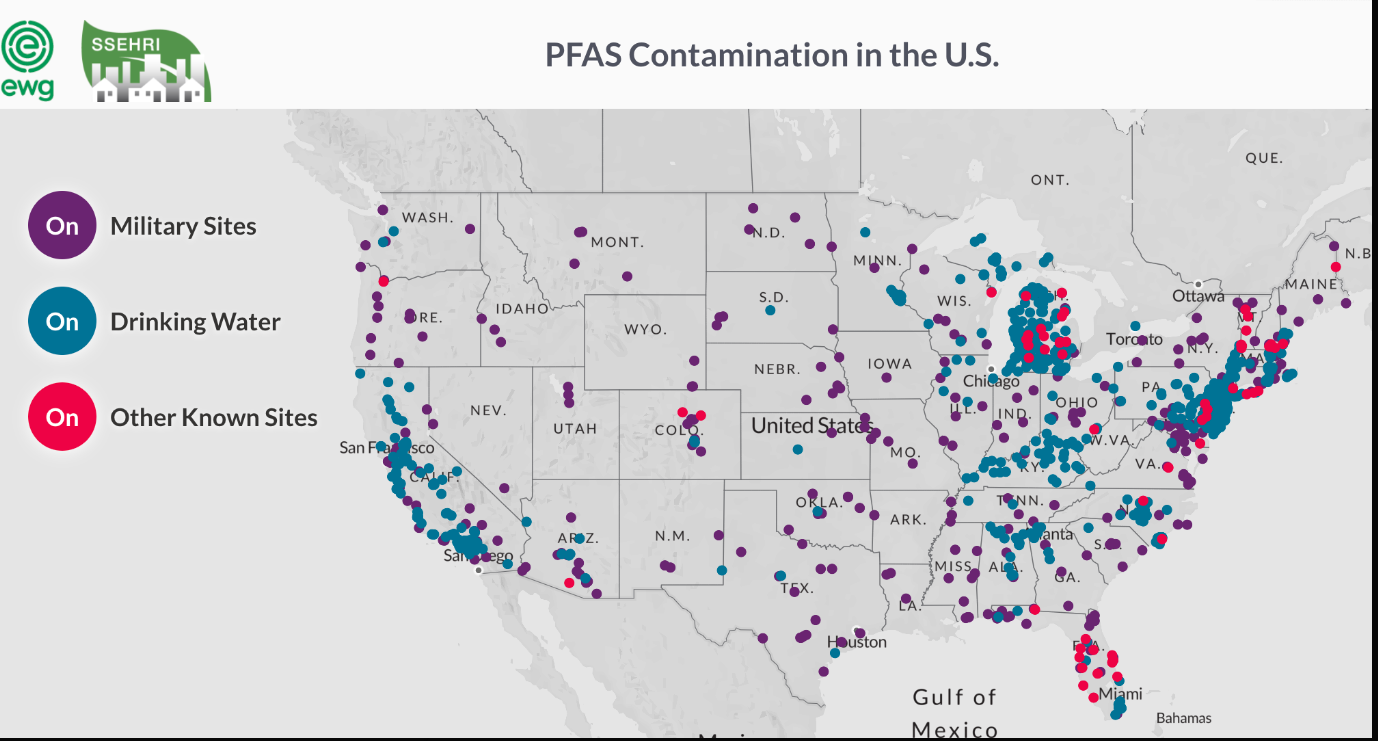
The issue of PFAS contamination is not confined to North Carolina. Across the United States, PFAS have been detected in water systems in all 50 states. The Environmental Working Group (EWG) reports over 8,800 sites with known PFAS contamination . States like Michigan, New Jersey, and California have identified numerous contaminated sites, prompting public health concerns and regulatory actions.EWG+1EWG+1AP News

Industrial Sources and Regulatory Challenges

Industrial facilities are significant contributors to PFAS pollution. In North Carolina, the Chemours Fayetteville Works plant has been under scrutiny for PFAS emissions, with reports indicating that contamination could persist in groundwater for decades . Despite efforts to regulate PFAS, challenges remain. For instance, proposed rules in North Carolina have been criticized for lacking enforceable limits and penalties, relying instead on voluntary compliance by industries .NC DPH Epidemiology+1The Guardian+1WRAL.com

Community Impact and Advocacy

Communities affected by PFAS contamination have expressed frustration over regulatory delays and insufficient action. Advocates in North Carolina have pushed for stricter state legislation in response to federal rollbacks on PFAS regulations . Public awareness and community engagement are crucial in addressing the PFAS crisis, ensuring that affected populations receive the necessary support and resources.North Carolina Health News

Conclusion

PFAS contamination represents a pressing environmental and public health issue in North Carolina and across the United States. The persistence of these chemicals in the environment and their associated health risks underscore the need for comprehensive regulatory measures, industrial accountability, and community advocacy. By staying informed and engaged, we can work towards mitigating the impact of PFAS and safeguarding our water resources for future generations.

Disclaimer: This blog is for informational purposes only and does not constitute legal or medical advice. If you believe you have been exposed to PFAS and are experiencing health issues, please consult with a qualified healthcare professional.

The Difference Between Fat Americans Today Versus 200 Years Ago: A Warning from A.L. Childers

In the last 200 years, America has seen a dramatic shift in what it means to be overweight. Over two centuries ago, being fat was often a symbol of wealth and prosperity. It indicated that one had the financial means to eat well and live comfortably. However, in today’s society, being overweight often points to a far more concerning reality: we are being poisoned by fake foods, harmful medications, and contaminated water. This shift is not just a change in perception but a warning sign of the systemic poisoning of our bodies and minds.

Poison in Our Water

The average tap water is not as safe as many believe. Various chemicals are introduced into our water supply under the guise of sanitation and safety. For example, fluoride is added to prevent tooth decay, but excessive fluoride can lead to skeletal fluorosis, a condition that damages bones and joints. Chlorine, used to kill harmful bacteria, can react with organic matter to form trihalomethanes (THMs), which have been linked to an increased risk of cancer. Moreover, other contaminants such as lead, pesticides, and pharmaceutical residues often find their way into our drinking water, further endangering our health.

The Safe Drinking Water Act (SDWA) of 1974 was established to protect the quality of drinking water in the U.S. by regulating the nation’s public water systems. Despite this, many contaminants still seep through due to industrial activities and agricultural runoff. Policies continue to evolve, but they often lag behind the rapid pace of contamination, and enforcement can be inconsistent, leaving citizens vulnerable.

Poison in Our Air

Air pollution is another silent killer. Corporations release hazardous chemicals into the air, contributing to smog, respiratory diseases, and even changes in our DNA structure. The Clean Air Act of 1970 aimed to control air pollution on a national level. However, despite amendments in 1990 to address issues like acid rain, urban air pollution, and toxic air emissions, many companies exploit loopholes, paying lobbyists to influence policy decisions in their favor.

For instance, the rollback of the Clean Power Plan in 2019 allowed for more lenient regulations on carbon emissions from power plants, exacerbating air quality issues and contributing to climate change. These regulatory changes are often influenced by corporate interests rather than public health concerns, highlighting a significant flaw in our system.

Poison in Our Food

Our food is laden with chemicals from pesticides, herbicides, and preservatives, all designed to enhance appearance, prolong shelf life, and increase yield. Glyphosate, a widely used herbicide, has been linked to cancer, while atrazine, another herbicide, has been shown to disrupt endocrine function and reproductive health.

The impact on our bodies is profound. These chemicals contribute to inflammation, obesity, diabetes, and a host of other chronic diseases. They also lead to costly doctor appointments and treatments that could be avoided with cleaner food sources.

The Food Quality Protection Act (FQPA) of 1996 was introduced to ensure a safer food supply by setting stricter safety standards for pesticides. Despite this, many harmful chemicals still make their way into our food chain due to industrial farming practices and insufficient regulatory oversight.

Poison in Our Meat

Animals raised for consumption are often injected with hormones and antibiotics to promote growth and prevent disease. These substances can remain in the meat, posing health risks to humans. Hormones like rBGH (recombinant bovine growth hormone) used in dairy cows have been linked to cancer, while the overuse of antibiotics contributes to the rise of antibiotic-resistant bacteria, a significant public health threat.

Corporate Influence and Policy

The intersection of corporate interests and public policy is where the root of the problem lies. Corporations invest heavily in lobbying efforts to shape regulations that favor their operations, often at the expense of public health. For example, the Chemical Safety Improvement Act of 2013 was designed to update the Toxic Substances Control Act of 1976, but critics argue that it fell short of adequately protecting consumers from harmful chemicals due to industry influence.

Conclusion

The contrast between the wealthy, well-fed Americans of 200 years ago and today’s chemically burdened population is stark and alarming. It’s a testament to how far we’ve strayed from natural, wholesome living. We must demand greater transparency and stricter regulations to protect our health and well-being. As a society, we need to be vigilant, educated, and proactive in addressing these issues, pushing back against corporate interests that prioritize profit over people. Let’s not be complacent; our health and the future of our nation depend on it.