
What secrets linger in the faces at a gilded banquet table—while just beyond the doors, the world groans under the weight of unseen hunger?
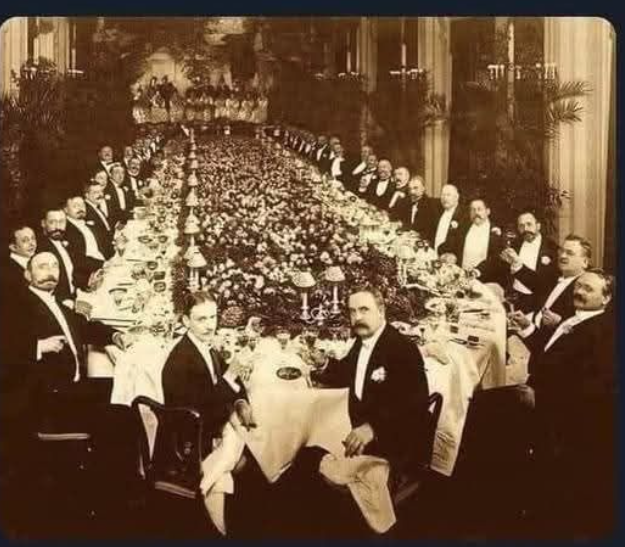
This stunning photograph—men in formal attire seated around a vast, lavishly set table—captures the essence of the Gilded Age (late 19th to early 20th century), a time when extravagant banquets symbolized both triumph and inequality.
What does a single photograph of an opulent banquet reveal about an age of excess, inequality, and societal control?
This image—featuring sharply dressed gentlemen seated around an expansive, lavishly arranged table—is a window into the Gilded Age (circa 1890–1910), a time when America’s richest flaunted their fortune through extravagant dining and grand social events.
The Feast in Focus
- Opulence Personified
Lavish banquets then were not mere meals—they were performances of wealth and power. The wealthy showcased their status by serving multi-course feasts: oysters or clams, soups, fish, roast meats, and a succession of entrées from heaviest to lightest, finishing with sherbet or punch grolierclub.omeka.net. - Banquet Photography: A Craft of Memory
Capturing such grandeur required special banquet cameras—giant-format tools designed to hold every face in focus, often spanning more than a dozen feet WikipediaPetaPixel. These photos served as trophies themselves—visual proof of influence.
The Photography of Opulence
This photo belongs to the tradition of banquet photography, a practice popular in the 1890s that employed giant-format cameras (e.g. 12×20 inches) to capture every face and detail across a long, spectacular table. These images commemorated events where presence signified power.Wikipedia
What The Banquet Meant for the Elite
Such dinners were more than food; they were performances of wealth and social dominance:
- The opulent table settings, formal attire, and polished demeanor broadcast clear messages of belonging and status.
- Emerging fashion symbols—like the tuxedo, which became fashionable after the 1886 Tuxedo Club event—underscored refined rebellion against old-world strict formalwear.The Saturday Evening Posttuxedopark-ny.gov
- Membership in elite circles, such as the Society of Patriarchs, often required strict control over guest lists and stage-managed appearances.Wikipedia
The Other Side of the Table
As opulence flourished behind closed doors:
- Outside—amongst poorer neighborhoods and laboring classes—the daily struggle for basic sustenance continued unchecked.
- Many families lived on meager wages, while industrialists and railroad barons refinanced their barns into mansions.Business Insider
This photograph captures the stark divide: those who lived as if money fixed all issues, and those who paid the price.
Why It Still Matters
Today, we still see this pattern:
- Lavish gala dinners, exclusive fundraisers, and curated social media lives all echo the same inequality and performative wealth.
- The image forces us to ask: What truths hide behind spectacle? Who gets visible, and who remains unseen?
Quick Snapshot Takeaways
| Element | Insight |
|---|---|
| Gilded banquet | A display of unrivaled status and economic domination |
| Banquet photography | A tool for immortalizing, not democratizing, power |
| Tuxedos and etiquette | Material signals of membership in a shrinking elite circle |
| The excluded masses | The unseen majority whose labor funded this display |
| Modern parallels | Virtual opulence via social media, influencer cultures, and exclusive brand moments |
mony, or elite monopoly—hide stories of exclusion, sacrifice, and power.
SEO Keywords
- Gilded Age banquet photography
- turn-of-century elite dinners
- banquet camera large format photography
- Gilded Age luxury inequality
- Tuxedo history 19th century America
What It Meant to the Elite
For those at the table, it was a moment of glory. Each glass raised, each exquisite course served was a statement of privilege and belonging. Invitations were coveted—every detail from napkin folds to tableware was designed to impress.
What It Meant to Everyone Else
Just a few blocks—or sometimes just a glance away—lived the working poor, the widows, and the immigrants. Families who could barely afford scraps watched from shadows while banquet halls overflowed. The dining table became a metaphor for society: only some were welcome at the feast, while many were left hungry.
Modern Relevance
This image still resonates today:
- We see similar rituals—galas, diplomatic dinners, luxury events—where power is performed publicly.
- Online banquets take other forms: Instagram influencers, sponsored lifestyles, social media as the modern dining table.
- Economic disparity persists: while elites toast in gilded rooms, millions worldwide face food insecurity and displacement.
Disclaimer
This post interprets a historical photograph through a critical lens of social inequality. References to the Gilded Age’s luxurious dinners and the mechanics of banquet photography are drawn from historical sources grolierclub.omeka.netWikipediaNational Women’s History Museum. The narrative reflects interpretation, not definitive history.
About the Author
A.L. Childers (Audrey Childers) is a writer and independent researcher drawn to the stories hidden between the lines of history—where power, food, and shadows intersect. She appreciates how a single image or a forgotten text can reveal deeper truths about society’s structures and silences.
SEO Keywords
- gilded age banquet photography
- historic grand dinners early 1900s
- social inequality in Gilded Age
- banquet camera history
- Gilded Age feasts and disparity

