
Chapter 1. The Claim and the Cost
A source-driven investigation of Cathar Christianity, the Interrogatio Johannis (“Secret Supper”), suppression and crusade, canon politics, and contested memories—told alongside primary texts and modern scholarship.
History is never neutral. It is written by the victors — those with the most to gain when their version becomes the only one that survives. The Catholic Church that emerged from Constantine’s empire claimed it alone carried Jesus’s authority, that salvation passed only through its sacraments, and that obedience to its hierarchy was obedience to God himself.
But another Christianity existed — one so threatening that Rome waged a crusade to erase it, and an inquisition to ensure it never rose again.
The Cathars believed that Jesus was not sent to build an institution. He was sent as an awakener — to expose the greatest deception of all time: that the god worshipped in temples and enthroned in cathedrals was not the God of Light, but the prince of darkness in disguise.
This was their claim. And the cost of believing it was everything.
Jesus as Awakener, Not Institution-Builder
For the Cathars, Jesus was not a lawgiver, priest, or king. He was the messenger of the true God of Light, revealing that the world itself was counterfeit. He did not come to establish sacraments or bless kingdoms — he came to awaken the divine spark within each soul.
They pointed to verses already in the Bible as evidence that this truth had always been hiding in plain sight:
- “The god of this world has blinded the minds of the unbelievers.” — 2 Corinthians 4:4
- “You belong to your father, the devil, and you want to carry out your father’s desires.” — John 8:44
- “Again, the devil took him to a very high mountain and showed him all the kingdoms of the world… ‘All this I will give you,’ he said, ‘if you bow down and worship me.’” — Matthew 4:8–9
Why would Satan offer Jesus the kingdoms of the world unless they were already his to give? Why would Paul call Satan “the god of this world” unless he truly ruled it?
The Cathars read these verses as confirmation that the God preached from pulpits was not the true Creator, but the Adversary masquerading as one.
The World as Prison
To the Cathars, the material world was not a gift but a prison. Birth was a trap, flesh a cage. The cycle of suffering kept souls enslaved to the false god.
This was not an isolated idea — it echoed Gnostic traditions and dualist movements like Manichaeism — but in medieval Europe, it carried radical consequences.
- If matter was corrupt, then sacraments of water, bread, and wine were powerless.
- If the God of the church was the “god of this world,” then its cathedrals and wealth were evidence of corruption, not holiness.
- If salvation was awakening, then no pope, priest, or king could claim to control it.
For the Cathars, Jesus’s mission was to free souls from the counterfeit world, not to sanctify it.
Who Had What to Gain — and What to Lose
This theology was not just heretical; it was destabilizing.
Who had what to gain?
- The papacy gained wealth, land, and legitimacy by claiming exclusive control of salvation.
- Monarchs allied with Rome gained divine sanction for their rule.
- The institutional church gained obedience, tithes, and fear as tools of control.
Who had what to lose?
- If the Cathars were right, the church’s sacraments were meaningless, its authority fraudulent, its wealth corrupt.
- Local nobles in Languedoc who tolerated or even protected Cathars saw the chance to resist Rome’s control.
- Ordinary people, freed from tithes and ritual, could reclaim spiritual autonomy — and that terrified the powers of their age.
To Rome, Cathar belief was not simply an error in doctrine. It was a direct threat to the machinery of empire.
Suppression and the Machinery of Power
By the twelfth century, the Catholic Church was the largest landowner in Europe and the most powerful institution in the West. In Languedoc, where Cathar communities flourished, Rome saw both theological and political danger.
Pope Innocent III moved swiftly. In 1209, he declared the Albigensian Crusade — a holy war not against Muslims in the Holy Land but against Christians in southern France. Crusaders were promised the same indulgences and spiritual rewards as if they fought in Jerusalem.
The result was brutal. Armies swept through Béziers, Carcassonne, and beyond. Towns were torched, libraries destroyed, entire populations put to the sword. The papal legate’s infamous command at Béziers — “Kill them all; God will know his own” — summed up the campaign’s spirit.
Heretics were not persuaded; they were annihilated. Their scriptures, including the Interrogatio Johannis, were burned. Their voices silenced.
But fire is a clumsy censor. Ashes can hide embers. And in archives — in Carcassonne, Vienna, and scattered fragments — this forbidden gospel endured.
The Claim and Its Cost
The Cathars’ claim was stark: Jesus revealed the world as counterfeit, ruled by a false god, and offered awakening as the way of escape.
The cost was immense: tens of thousands dead, an entire culture exterminated, a Christianity of awakening reduced to whispers.
The church called it heresy. The inquisitors called it evidence. The Cathars called it truth.
And centuries later, we are left with the question they asked and died for:
Who, truly, have we been worshipping?
Why This Matters
This book does not ask you to blindly adopt the Cathar worldview. It asks you to question why their voices were erased.
- Why did Rome unleash crusade and inquisition not against pagans but against fellow Christians?
- Why did they fear so much a gospel that told people they already carried the spark of God within?
- Who benefitted from silencing this “other Christianity,” and who paid the cost?
The Christianity we were handed is not the only one that ever existed. The fragments of the Forbidden Gospel of John remain, daring us to see past the empire’s story and ask whether Jesus came to confirm the god of this world — or to expose him.
Resources & References
- Barber, Malcolm. The Cathars: Dualist Heretics in Languedoc in the High Middle Ages. Longman, 2000.
- Wakefield, Walter L., and Austin P. Evans. Heresies of the High Middle Ages. Columbia University Press, 1991.
- Peters, Edward. Inquisition. University of California Press, 1988.
- O’Shea, Stephen. The Perfect Heresy: The Life and Death of the Cathars. Walker & Co., 2000.
- Pagels, Elaine. The Gnostic Gospels. Vintage Books, 1989.
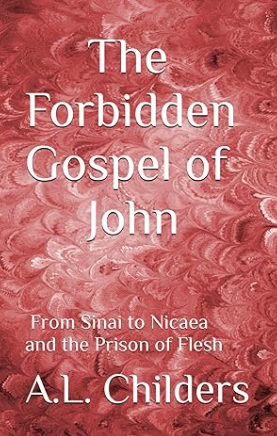
The Forbidden Gospel of John: From Sinai to Nicaea and the Prison of Flesh
About the Author
A.L. Childers is a writer and researcher who refuses to stop at the surface of things. Her work digs into history, symbols, and the hidden stories that shape culture and politics today. By blending truth, curiosity, and raw honesty, she writes for the people who are tired of being told half-truths.
Disclaimer
This blog is for educational and historical purposes only. It does not endorse or condemn any religion, culture, or nation. Its purpose is to examine the historical and symbolic use of the hexagram and to explore how symbols move between occult traditions and cultic institutions.


