Tag Archives: #slavery

Born Into the Ledger—Where It Was Best — and Worst — to Be Born Black or White in the 1800s

Where It Was Best — and Worst — to Be Born Black or White in the 1800s (And Why It Was Never About Color)

This was never a race war.
It was always a class war.
And the elites wrote the story to keep us from noticing.

Born Into the Ledger

There is a certain lie that settles into a society the way dust settles into floorboards — quietly, patiently, until no one remembers what the room looked like before it arrived. It is the lie that suffering has a color, that freedom is inherited through skin, and that history can be cleanly divided into villains and victims based on appearance alone. The 1800s tell a different story, if one is willing to read it slowly, by candlelight rather than headline.

In that century, the most dangerous thing a human being could be was not Black or white — it was poor.

To be born Black in the American Deep South was to be born already counted, already priced, already owned. From the moment breath entered the lungs, it belonged to someone else. Families were dismantled as easily as furniture rearranged. Education was forbidden not because it was useless, but because it was powerful. Bodies were worked until they failed, and when they did, they were replaced without ceremony. This was racialized chattel slavery — brutal, unmistakable, and engineered to strip a person not only of freedom, but of identity itself.

And yet, while this form of slavery was among the most visible and violently enforced, it was not the only system of human ownership operating in the 1800s.

Across the ocean, in the vast cold stretches of the Russian Empire, millions of white peasants were born into serfdom — a word softened by distance, but sharpened by reality. They could be bought and sold with the land they worked, traded between nobles, beaten legally, separated from their families, conscripted into military service, and barred from leaving the estate of their birth. Over a third of Russia lived this way until emancipation arrived in 1861, long after the damage had already been written into bone and blood. They were white. They were Christian. They were owned.

In Ireland, also white and Christian, the chains were quieter but no less lethal. Land was taken, rented back at impossible prices, and governed by absentee landlords who lived comfortably elsewhere. When the potato failed, food continued to be exported while people starved. One million died. Another million fled. It was not slavery by name, but it was domination by design — engineered scarcity enforced by empire.

In England’s industrial cities, white children disappeared into coal mines before they learned their letters. Women stood at looms until their fingers failed. Men breathed in poison until their lungs surrendered. This was called progress. This was called employment. The people living it called it survival. “Wage slavery” entered the language not as metaphor, but as recognition — because freedom that leads only to starvation is not freedom at all.

And still, above all of this, sat the elites.

They wore different coats depending on the country — powdered wigs, military uniforms, tailored suits — but their interests aligned perfectly. British aristocrats, plantation owners, Russian nobles, industrial magnates, colonial governors, banking families, merchant elites. They owned land. They owned factories. They owned ships. They owned laws. They owned people — whether those people were called slaves, serfs, tenants, apprentices, or laborers.

When chattel slavery became inconvenient, they rebranded it. Sharecropping replaced chains. Debt replaced whips. Company towns replaced plantations. The ledger remained.

There were, of course, places where the burden of birth was lighter. To be born Black in Canada in the 1800s was to step into a world without legal chains. Slavery had been abolished. Fugitive slave laws did not reach across the border. Black communities governed themselves, owned land, educated their children, and lived with a degree of safety unimaginable just a few miles south. Racism did not vanish — but ownership did.

In Haiti, newly freed from French rule, Black people governed themselves entirely. It was imperfect, punished economically by the same European powers who claimed enlightenment, but it stood as a living contradiction to the lie that Black freedom required white oversight.

For white people, the safest births occurred not in empires, but in places that had dismantled inherited domination. Switzerland, neutral and decentralized, offered legal personhood even to the poor. Canada and the northern United States offered land, mobility, and political participation unavailable to Europe’s peasantry. Not equality — but protection.

The pattern is impossible to ignore once seen: where elites held unchecked power, everyone beneath them suffered — regardless of color. Race shaped the method. Class decided the fate.

This is why the oldest trick in the book has always been division. When poor Black laborers and poor white laborers began to notice they were trapped in the same machinery, the elites rewrote the narrative. They taught people to argue over skin instead of systems, identity instead of income, ancestry instead of access. Because a divided working class never looks up. It never storms the manor. It never questions who owns the ledger.

The 1800s were not a morality play of color alone. They were a warning — one we are still ignoring.

Different skin. Same chains. Different century. Same elites.


Disclaimer

This article is intended for historical education and social analysis. It does not minimize or deny the unique brutality of racialized chattel slavery, nor does it seek to compare suffering competitively. Its purpose is to examine systems of power and exploitation across race and class to reveal how elites historically maintained control by dividing the poor — a strategy that continues today.


References & Resources

  • Orlando Patterson, Slavery and Social Death
  • Eric Foner, Give Me Liberty
  • Edmund S. Morgan, American Slavery, American Freedom
  • Sheila Fitzpatrick, Russian Serfdom
  • Adam Hochschild, Bury the Chains
  • C.L.R. James, The Black Jacobins
  • British National Archives (Industrial labor records)
  • Library and Archives Canada (Black settlements and abolition records)

About the Author

A.L. Childers is a writer and historical researcher focused on power systems, suppressed histories, and the narratives elites rely on to maintain control. Her work challenges simplified versions of the past and asks readers to look beyond identity-driven divisions to the structures that shape human lives across centuries.


American Slavery: Reframing the Narrative Toward Truth and Unity

Disclaimer: This blog reflects historical research and personal interpretation. It is not meant to minimize suffering but to re-examine the larger history of slavery and America’s role in ending it.


The Global History of Slavery

When most Americans think of slavery, they picture early English colonists sailing to Africa, throwing nets over people on beaches, and dragging them to ships. This is a myth promoted by oversimplified history books. The truth is far more complex:

  • Slavery existed across the world for thousands of years before America was even founded. Ancient civilizations like Egypt, Greece, Rome, China, and the Ottoman Empire all practiced slavery.
  • In Africa, slavery was not only present but was an established system long before Europeans arrived. African kingdoms and warlords captured rival tribes and sold them to traders. Europeans (and later Americans) were middlemen in a trade Africans themselves controlled locally.

Historian John Thornton notes:

“Europeans did not have the military power to capture Africans inland. They depended on African states and merchants to sell slaves.” (Thornton, Africa and Africans in the Making of the Atlantic World, 1400–1800)

SEO Keywords: global slavery history, African slave trade, truth about American slavery.


America’s Role in Ending Slavery

Here’s what rarely gets taught:

  • The United States was one of the first nations to outlaw the international slave trade in 1808.
  • Within less than 100 years of its founding, America fought a bloody Civil War (1861–1865) that killed over 600,000 men to end slavery once and for all.
  • Britain, too, abolished slavery in 1833, but many European nations kept forms of servitude much longer.
  • Today, no other country fought a war as devastating and self-sacrificial as America did to end slavery on its own soil.

This doesn’t erase the horrors of slavery, but it reframes America not only as a participant—but as one of the first global leaders to fight for abolition.

References:

  • U.S. Constitution, Article I, Section 9 (1808 ban on slave trade).
  • James M. McPherson, Battle Cry of Freedom (Civil War and abolition).

The Modern Slave Trade: A Hard Truth

Slavery did not end globally with America’s Civil War. In fact, modern slavery still exists today, especially in parts of Africa.

  • The Global Slavery Index (2023) estimates over 50 million people are enslaved worldwide, including forced labor, forced marriage, and trafficking.
  • In countries like Mauritania, hereditary slavery persists, where children are born into bondage.
  • In Libya, CNN reported slave auctions as recently as 2017, where migrants were sold for as little as $400.

References:

  • Global Slavery Index, Walk Free Foundation (2023).
  • CNN, “People for Sale: Where lives are auctioned for $400 in Libya” (2017).

This truth matters: America is blamed relentlessly for slavery, while modern slavery is ignored. If we’re going to tell history honestly, we must tell the whole story.


The Narrative Problem: Division vs. Unity

The sad reality is that many people in America are being taught a one-sided story:

  • That slavery was uniquely American.
  • That “white Americans” alone are to blame.
  • That we must constantly divide ourselves into victim and oppressor.

But the facts say otherwise:

  • No race has a monopoly on suffering or oppression. Every culture in history has been both enslaved and enslaver.
  • America is the only nation that not only abolished slavery early but also fought a devastating war to enforce freedom.
  • Black Americans have risen to the highest offices of the land—Barack Obama, our first Black president, was elected by a majority of white voters.

The constant focus on division benefits politicians, media personalities, and corporations—not everyday Americans.


Stop Making Victims, Start Celebrating Victors

The real story isn’t that African Americans are forever victims. It’s that they are victors—descendants of survivors who overcame slavery, Jim Crow, and systemic challenges to thrive.

America is strongest when it celebrates unity, resilience, and shared progress, not when it is divided by race wars stoked for profit and power.

As Frederick Douglass, a former slave turned abolitionist, said:

“We have to do with the past only as we can make it useful to the present and the future.”


Final Word: A Higher Standard for America

America should be appreciated—not demonized—for being among the first to take a stand against slavery. That doesn’t mean ignoring our painful history—it means telling the whole truth:

  • Slavery was a global system, not an American invention.
  • African elites sold their own people into bondage.
  • America ended slavery through law, war, and sacrifice faster than almost any other nation.
  • Slavery still exists in Africa and other parts of the world today—yet rarely gets attention.

The only way forward is through honest history, unity over division, and refusing to let elites rewrite the story to pit Americans against each other.


About the Author

I’m A.L. Childers, a writer and researcher passionate about truth, history, and unity. My work challenges misleading narratives and seeks to uplift readers with honesty and perspective. I believe that America’s story is not one of shame, but one of resilience and redemption.

The Truth About the Transatlantic Slave Trade: A Complex History That Deserves Compassion, Not Blame

There’s a narrative that has echoed through generations: that the transatlantic slave trade was the sole result of European greed and brutality. While that statement contains truth, it also simplifies a deeply complex, multi-layered history involving multiple nations, races, and systems.

It’s time we talk honestly — not to excuse, but to understand. Because when we reduce history to blame alone, we lose the opportunity to heal, learn, and grow together.


🧭 What the Records Actually Say

The transatlantic slave trade lasted from roughly 1501 to 1866 and involved the forced migration of over 12 million Africans, about 10.7 million of whom survived the grueling voyage to the Americas.

Key Stats:

  • Over 36,000 voyages transported enslaved Africans to the Americas.
  • Source: SlaveVoyages.org – Trans-Atlantic Slave Trade Database
  • The majority of enslaved Africans were sent to Brazil and the Caribbean, not the United States.
  • Source: Gilder Lehrman Institute of American History

🌍 Who Captured and Sold the Africans?

One of the hardest truths for many to accept is this:

Most Africans were not kidnapped by white Europeans directly.
They were sold by other Africans—rival tribes, kingdoms, and merchants who participated in the trade.

Powerful African kingdoms such as:

  • Dahomey (present-day Benin)
  • Ashanti (Ghana)
  • Oyo (Nigeria)
    actively raided neighboring tribes and sold captives at coastal slave markets.

These transactions were often in exchange for:

  • Guns
  • Textiles
  • Alcohol
  • Manufactured goods

📚 Source:


🧑🏻‍🌾 What About White Servants?

While chattel slavery was unique in its cruelty, Europeans also experienced servitude:

  • Between the 1600s and 1770s, over 300,000–500,000 white Europeans came to America as indentured servants.
  • Most were poor, orphaned, imprisoned, or debt-ridden.
  • They served 4–7 years in exchange for passage to the New World.

Some died before their contract ended. Some were tricked or kidnapped. But unlike enslaved Africans, indentured servants:

  • Had a defined end to their service
  • Could legally marry
  • Could own property after freedom
  • Were not born into servitude

📚 Sources:


🧠 Why This Truth Matters

It’s easy to adopt a black-and-white (no pun intended) version of history, but real change comes when we:

  • See the full picture
  • Recognize shared responsibility
  • Stop vilifying entire races for the sins of specific systems and elites

Yes, the transatlantic slave trade was horrific.
Yes, European powers built empires on human suffering.
But also yes — many African leaders were complicit, and other races and ethnicities suffered within the same global system.


✨ A More United Perspective

If we’re going to educate future generations and break cycles of division:

  • We must move from blame to understanding
  • From shame to truth
  • From anger to action

Only then can we honor the pain of our ancestors while creating something better for their descendants.


📜 Disclaimer

This blog is not written to minimize or excuse the horrors of slavery. The intention is to provide historical context that is often left out of mainstream narratives. Understanding all sides of this history allows for honest dialogue, critical thinking, and collective healing.

We must never forget the suffering, but we must also not simplify it. History is complicated — because people are complicated.


🙏 Final Thoughts

No race has a monopoly on cruelty or compassion.
The story of slavery is not the story of the “white man vs. the Black man.” It is the story of power, greed, empire, and human exploitation — and how people of all backgrounds were pulled into its machinery.

Let’s stop blaming each other. Let’s start educating each other.

Because the real enemy?
It was never a race.
It was the system that treated people like property — and the silence that let it happen.

The Southern New Year Celebration

The Southern New Year Celebration is a worldwide celebration for the beginning of the New Year. These festivals are among the oldest and the most universally observed.  This book takes you on a journey of the Southeastern part of America, honoring two southern states called North and South Carolina and sharing its rich history of southern superstition, tradition, culture, and lore.

Many believe, including myself, that what you do on News Years Day, you will do all year-While most of these superstitions and traditions are meant to usher in good luck and keeping bad luck at bay, what you do can reflect how you’ll live in the coming year.

My 6th generation great-great-great grandfather James Dawkins emigrated to the U.S. 10 years before the Irish Potato Famine, also known as the Great Hunger, which began in 1845.

There is a story that has been passed down through the generations that James Dawkins was in The Battle of Churubusco.

 During the U.S. invasion of Mexico in 1846, 200 plus Irish immigrants from the U.S. formed the Saint Patrick’s battalion and joined the Mexican side. From mistreatments, the catholic Irish saw parallels between the mistreatment of catholic Mexicans with their own mistreatment buy the British.  Although it consisted of mostly Irish immigrants, it also included black Americans who escaped slavery. Their flag read “Erin go Bragh ” which means Ireland Forever.”  Many were eventually captured in the battle of Churubusco.

In their final act of defiance, 30 men cheered The Mexican flag before they were hung. This isn’t typically taught in a U.S. history book lesson.

 However, Irish descendants still sing songs to uphold the legacy. Mexico holds joint commemorations with Ireland every year to celebrate this history, and there are statues of John Riley around Mexico.

My great-great-great grandfather James Dawkins survived that battle and escaped to North Carolina where he was already the father of George W. Dawkins of Robeson, NC born in 1840, who later married Martha Dawkins (Butler) of Laurel Hill, NC born 1860. They were the grandparents of my grandmother Martha Eva Shoemake of Gibson, NC born in Scotland County 1921.

I am the living link to my family history. I will tell my children the stories of all the struggles waged at home and in foreign parts from generations past. Of the sacrifices made for our freedoms, the struggles, the lessons learned and will tell them my own story as well because everybody has a story to tell.  

 I was born and raised in the southern eastern part of South Carolina, in a county called Marlboro.

When I eat the food that my grandma used to make, instantly I feel transported back to a simpler time and families meant something to each other.  

The memories and sweet smells from my childhood are the ultimate reason why I keep my southern traditions. I remember visiting my grandmother on many humid and hot Sunday’s afternoon after church; all the windows were open. There was no sneaking up on my grandmother no matter how fast or slow I entered; the rusty hinges from that old wooden screen door squealed like fingernails scrapping across a dusty old school chalkboard. As the old wooden door would snap shut.

My grandmother would be in the kitchen, humming an old gospel song, rolling out piecrust with a wooden rolling pin, and crimping the edges of the pastry with the tips from her arthritic fingers.

Depending on which part of the south you are from, the cooking style and the ingredients can vary.

There is a rich history in southern superstition, tradition, and culture. Southerners have a strong sense of regional heritage, and this is why I believe southern food belongs to a region, not a race or ethnicity. Never forgetting our ancestry but started creating new methods, with minimal equipment and scarce resources; using every portion of edible scraps in the home—nothing ever went to waste. Southern style food is not only about how we nurture people with every mouthful, but it tells a story of survival from each ingredient. 

I love trying out new recipes and experimenting with different flavors. Cooking is not just about nourishment for me, but also a fun and creative outlet. There’s something so satisfying about seeing a dish come together and enjoying the result. Whether it’s trying out a new fusion cuisine or simply recreating a childhood favorite, food always makes for a fun activity.

I hope you all enjoy this book along with cooking a few recipes and sharing them generously with friends and family while keeping the Southern News Year’s Day superstition, tradition, culture and lore to be never forgotten. 

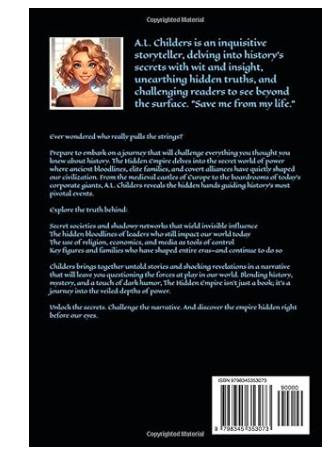
The Hidden Empire: A Journey Through Millennia of Oligarchic Rule

The Hidden Empire: A Journey Through Millennia of Oligarchic Rule
by A.L. Childers

Description:
What if history as you know it was shaped by an invisible empire—an elite circle of families and powerful figures who have ruled behind the scenes for centuries? Welcome to The Hidden Empire, a journey that reveals the secrets of the world’s true architects of power. From the opulent halls of medieval castles to the skyscrapers of today’s corporate giants, this book uncovers how oligarchs have controlled and manipulated society throughout history.

A.L. Childers masterfully weaves together centuries of untold stories, secret societies, and shadowy alliances to show how the game of power has always been rigged. Discover the fascinating ties between royalty, the church, and modern corporations; learn about the hidden bloodlines of global leaders; and explore the carefully placed events, financial systems, and media networks designed to keep us all in line.

Blending historical research with compelling storytelling, The Hidden Empire is a must-read for anyone intrigued by hidden histories and the unseen forces that shape our world. This isn’t your typical history book—it’s a captivating exposé that will leave you questioning everything you thought you knew. And remember: the truth is often stranger than fiction.

Click on the title to order your book today~!!

The Hidden Empire: A Journey Through Millennia of Oligarchic Rule

  • Read a sample-

Introduction from the Author: A.L. Childers

Welcome, dear reader, to a journey that will take you through the hidden corridors of power, spanning millennia of control, manipulation, and unseen influence. The Hidden Empire: A Journey Through Millennia of Oligarchic Rule is not just a history book. It is an unveiling—a revelation of the forces that have shaped the world we live in today.

Since the dawn of recorded time, the powerful few have governed the many, crafting narratives that convince us we are free when, in truth, we remain bound by invisible chains. From the thrones of ancient kings to the boardrooms of modern corporations, this empire has operated in the shadows, passing down control from one generation of oligarchs to the next. While history books celebrate revolutions and victories, the real victors have been the ones who never left power, merely changing their faces as the world evolved around them.

As I began writing this book, I knew it would be a journey unlike any I had undertaken before. History, as you and I have known it, is incomplete—a carefully crafted story meant to conceal the true forces at play. My intention is to pull back the curtain and reveal what has been hidden: the same bloodlines, the same families, and the same strategies of control that have ruled over humanity for centuries.

As a writer, I find inspiration in the greats—Mary Shelley, Charles Dickens, Jane Austen, and Bram Stoker—each of whom explored the intricacies of human nature, society, and power. Like them, I aim to capture both the beauty and the horror of our shared history. But while Shelley explored the tortured soul of a creator and Stoker wrapped us in gothic suspense, I seek to uncover the very soul of our civilization—the secret empire that has shaped our world.

This is not just a story about the past; it is a revelation about the present. You, like me, are a part of this system—whether you realize it or not. The chains of control have been carefully hidden, but they are no less real. The time has come to see the world as it truly is.

So, as you turn these pages, prepare to question everything you thought you knew about history. Prepare to see the patterns of control that span from ancient Egypt to the modern era. And most importantly, prepare to understand how the empire that has ruled for millennia continues to rule today—through new methods, under new names, but with the same singular goal: power.

Thank you for joining me on this journey. Together, we will uncover The Hidden Empire.

Disclaimer

The information and recipes in the blog are based on the author’s research and personal experiences. It’s for entertainment purpIt’s only. Every attempt has been made to provide accurate, up-to-date, and reliable information. No warranties of any kind are expressed or implied. Readers acknowledge that the author does not render legal, financial, medical, or professional advice. By reading this blog, the reader agrees that under no circumstance the author is not responsible for any direct or indirect loss incurred by using the information contained within this blog. Including but not limited to errors, omissions, or inaccuracies. This blog is not intended to replace what your healthcare provider has suggested.  The author is not responsible for any adverse effects or consequences from using any of the suggestions, preparations, or procedures discussed in this blog. All matters about your health should be supervised by a healthcare professional. I am not a doctor or a medical professional. This blog is designed as an educational and entertainment tool only. Please always check with your health practitioner before taking any vitamins, supplements, or herbs, as they may have side effects, especially when combined with medications, alcohol, or other vitamins or supplements.  Knowledge is power, educate yourself and find the answer to your healthcare needs. Wisdom is a beautiful thing to seek.  I hope this blog will teach and encourage you to take leaps in your life to educate yourself for a happier & healthier life. You have to take ownership of your health.

The views and services offered by Thehypothyroidismismchick.com are not intended to be a substitute for professional medical assistance but as an alternative for those seeking solutions for better health. We do not claim to diagnose, treat, prevent, or cure any disease but simply help you make physical and mental changes in your own body to help your body heal itself. Remember that results may vary, and if you are pregnant, nursing, taking medications, or have a severe condition, you should consult a physician or other appropriate medical professional before using any products or information on this site. Thehypothyroidisimchick.com assumes no responsibility for the use or misuse of this material. Your use of this website indicates your agreement to these terms. Our full disclosure, terms of use, and privacy policy.

The information on this site is not intended or implied to be a substitute for professional medical advice, diagnosis, or treatment. All content, including text, graphics, images, and information on or available through this website, is for general information purposes only. Opinions expressed here are the opinions of the writer. Never disregard professional medical advice or delay seeking medical treatment because of something you have read or accessed through this website.

This site is designed for educational purposes only and is not engaged in rendering medical advice, legal advice, or professional services. If you feel that you have a medical problem, you should seek the advice of your physician or health care practitioner. For additional information, please see Our full disclosure, terms of use, and privacy policy.

Our full disclosure, terms of use, and privacy policy. | thehypothyroidismchick

This piece was inspired by timeless wisdom and the understanding that true success lies not in the small battles, but in the pursuit of one’s purpose. –A.L. Childers

The Peasants’ Revolt of 1381: England’s Uprising Against Feudal Oppression

n 1381, England witnessed one of the most significant uprisings in its medieval history: The Peasants’ Revolt. This was not merely a rebellion sparked by high taxes or localized grievances, but a powerful, widespread insurrection against a deeply entrenched system of feudalism that had oppressed the lower classes for centuries. What began as a protest over unfair taxation quickly grew into a full-scale revolt, shaking the foundations of medieval society.

Through extensive research into historical documents, court records, and academic studies, I aim to provide a deeper understanding of the Peasants’ Revolt, its causes, its impact, and the long-term consequences that reverberated through English society.

The Seeds of Discontent: Economic Hardships and Unfair Taxes

The roots of the revolt can be traced to a series of economic pressures that weighed heavily on the lower classes, particularly the peasants. The Black Death (1347–1351) had drastically reduced England’s population, leading to labor shortages and giving peasants more bargaining power for wages. However, in the decades following the plague, England’s ruling class passed laws to suppress these gains, such as the Statute of Labourers (1351), which capped wages and restricted the movement of workers.

On top of this, the government imposed an increasingly heavy tax burden on the population. The most infamous of these was the poll tax—a flat tax levied on every individual, regardless of income. By 1381, this tax had been raised to an unprecedented level to fund military campaigns, including the costly war against France. For many, this was the final straw.

Peasants, already suffering under the weight of an oppressive feudal system that bound them to the land and their lords, found themselves facing an impossible situation: low wages, high taxes, and little hope for change. The poll tax, in particular, became a lightning rod for unrest, leading to an outcry that would soon turn into a revolt.

The Spark: The Killing of a Tax Collector

In the town of Brentwood, Essex, tensions finally boiled over. When a royal tax collector attempted to enforce the poll tax, a group of peasants, infuriated by the injustice, attacked him. This act of defiance quickly spread throughout the county and beyond, as news of the revolt reached neighboring Kent, where the uprising gained even more traction.

One of the leaders who emerged from the Kentish rebellion was Wat Tyler, a charismatic figure who, along with John Ball, a radical preacher, galvanized the peasants to rise up against their feudal masters. Ball, in particular, gave voice to the frustrations of the lower classes, preaching equality and challenging the notion that nobles had the divine right to rule. His famous question, “When Adam delved and Eve span, who was then the gentleman?” resonated deeply with the rebels.

The March to London: Demands for Justice

As the revolt gained momentum, peasants from all over southern England began marching toward London, intent on confronting the young King Richard II and demanding redress for their grievances. Their demands were radical for the time: they wanted the abolition of serfdom, the end of feudal obligations, fair wages, and the removal of corrupt royal officials.

By mid-June 1381, the rebels had reached London, where they were joined by sympathizers, including some members of the city’s working class. What followed was a chaotic few days in the capital. The rebels stormed the Tower of London, executed the Archbishop of Canterbury, and burned the palace of John of Gaunt, the king’s uncle, who was seen as a symbol of royal corruption and oppression.

King Richard II, then only 14 years old, appeared to negotiate with the rebels at Mile End and later at Smithfield. At first, he made promises to address their demands, but these promises were merely a tactic to buy time and calm the situation.

The Fall of Wat Tyler and the Collapse of the Revolt

The defining moment of the revolt came at Smithfield on June 15, 1381. During a meeting with King Richard, Wat Tyler was struck down and killed by the mayor of London, William Walworth. Tyler’s death demoralized the rebels, and with their leader gone, the uprising quickly unraveled.

King Richard, who had appeared conciliatory just days before, now turned to brutal repression. The king’s forces hunted down and executed the leaders of the revolt, including John Ball. The promises made to the peasants were rescinded, and the uprising was crushed with a ruthlessness that sent a clear message to any who might consider rising up again.

The Aftermath and Legacy of the Revolt

Though the Peasants’ Revolt failed to achieve its immediate aims, its long-term impact was profound. The revolt exposed the deep discontent among the lower classes and the weaknesses in the feudal system. In the years following the revolt, many of the harsh feudal obligations were gradually relaxed. Serfdom, while not immediately abolished, began to decline as a result of both economic pressures and the awareness that continued oppression could lead to further unrest.

The Peasants’ Revolt of 1381 also had significant political and cultural ramifications. It was one of the first mass movements in England’s history where common people, driven by a sense of injustice, rose up to challenge the authority of the ruling elite. Although they were ultimately defeated, the rebellion forced the ruling class to reconsider their methods of governance and to acknowledge the growing power of the people they ruled.

Historical Documentation and References

The Peasants’ Revolt is well-documented in both contemporary and later historical accounts. One of the most important sources is the Chronicles of Froissart, which provides a detailed narrative of the events. Froissart’s account, though written from the perspective of the nobility, offers valuable insights into the causes and course of the revolt.

The Westminster Chronicle and the Anonimalle Chronicle also offer contemporary accounts of the revolt, giving us glimpses into the fears and concerns of both the rebels and the authorities. These chronicles highlight the widespread nature of the rebellion and the shock it caused among the ruling classes.

In addition to primary sources, numerous modern scholars have explored the revolt in detail. R.B. Dobson’s book, The Peasants’ Revolt of 1381, is one of the most comprehensive modern studies of the uprising, providing an in-depth look at both the social and political factors that led to the revolt and its lasting impact on English society.

Conclusion

The Peasants’ Revolt of 1381 was a pivotal moment in English history, a time when ordinary men and women stood up against a system that had oppressed them for generations. Though their efforts were met with brutal force, their courage planted the seeds of change that would eventually contribute to the dismantling of the feudal system.

As we reflect on the events of 1381, we see echoes of these struggles in modern movements that challenge entrenched systems of power. The Peasants’ Revolt reminds us that history is not just shaped by kings and nobles, but by the actions of ordinary people who dare to demand justice.

References:

  1. Dobson, R.B. The Peasants’ Revolt of 1381. Macmillan, 1983.
  2. Froissart, Jean. Chronicles. Penguin Classics, 1968.
  3. Saul, Nigel. Richard II: A Troubled Reign. Yale University Press, 1997.
  4. Oman, Charles. The Great Revolt of 1381. Clarendon Press, 1906.
  5. Hilton, Rodney. Bond Men Made Free: Medieval Peasant Movements and the English Rising of 1381. Routledge, 2003.

By A.L. Childers
Author and Historian

About the author

Audrey Childers is an accomplished author, blogger, freelance journalist, and entrepreneur who has been writing and researching for over a decade. She is the creator and founder of Thehypothyroidismchick.com, a website that provides helpful tips for those living with hypothyroidism. Audrey loves spending time with her children and promoting optimal health and wellness for everyone. She has written over 200 books, including A survivors cookbook guide to kicking hypothyroidism booty, Reset Your Thyroid,The Ultimate Guide to healing hypothyroidism, and A survivors cookbook guide to kicking hypothyroidism booty: the slow cooker way All of Audrey’s books can be found on Amazon. This blog can be freely re-posted with proper attribution, author bio, and copyright statement.

Thehypothyroidismchick.com is a reliable source of health and science news relevant to our generation. They cover a wide range of stories but focus on contributing to their readers’ understanding of a complex and constantly changing field of information. They are driven by two core values: to provide accurate and informative content and to keep in mind the ultimate “smell test” – stories worth discussing with friends at a bar. At Thehypothyroidismchick.com, coverage is determined based on relevance, clinical significance, and editorial integrity. They do not prioritize commercial considerations and always clearly distinguish between factual content, commentary, and opinions to avoid misleading readers with institutional propaganda and speculation. This ensures that readers can trust the information they receive and make informed decisions about their health.

Please follow along with me on this journey of discovery as I share my brush of madness with exquisite clarity. Luckily, I was never a quick fix-it junkie where I said no to many suggestions from board-certified or certifiable doctors because I felt it in my soul that it was merely a bonafide being placed on my issues. The names of sure doctors have been changed because, frankly, I don’t want to be sued for proven the lack in their field. 

Hippocrates was right when he said: Let the food be thy medicine and thy medicine be thy food.

Disclaimer

The information and recipes in the blog are based on the author’s research and personal experiences. It’s for entertainment purpIt’s only. Every attempt has been made to provide accurate, up-to-date, and reliable information. No warranties of any kind are expressed or implied. Readers acknowledge that the author does not render legal, financial, medical, or professional advice. By reading this blog, the reader agrees that under no circumstance the author is not responsible for any direct or indirect loss incurred by using the information contained within this blog. Including but not limited to errors, omissions, or inaccuracies. This blog is not intended to replace what your healthcare provider has suggested.  The author is not responsible for any adverse effects or consequences from using any of the suggestions, preparations, or procedures discussed in this blog. All matters about your health should be supervised by a healthcare professional. I am not a doctor or a medical professional. This blog is designed as an educational and entertainment tool only. Please always check with your health practitioner before taking any vitamins, supplements, or herbs, as they may have side effects, especially when combined with medications, alcohol, or other vitamins or supplements.  Knowledge is power, educate yourself and find the answer to your healthcare needs. Wisdom is a beautiful thing to seek.  I hope this blog will teach and encourage you to take leaps in your life to educate yourself for a happier & healthier life. You have to take ownership of your health.

The views and services offered by Thehypothyroidismismchick.com are not intended to be a substitute for professional medical assistance but as an alternative for those seeking solutions for better health. We do not claim to diagnose, treat, prevent, or cure any disease but simply help you make physical and mental changes in your own body to help your body heal itself. Remember that results may vary, and if you are pregnant, nursing, taking medications, or have a severe condition, you should consult a physician or other appropriate medical professional before using any products or information on this site. Thehypothyroidisimchick.com assumes no responsibility for the use or misuse of this material. Your use of this website indicates your agreement to these terms. Our full disclosure, terms of use, and privacy policy.

The information on this site is not intended or implied to be a substitute for professional medical advice, diagnosis, or treatment. All content, including text, graphics, images, and information on or available through this website, is for general information purposes only. Opinions expressed here are the opinions of the writer. Never disregard professional medical advice or delay seeking medical treatment because of something you have read or accessed through this website.

This site is designed for educational purposes only and is not engaged in rendering medical advice, legal advice, or professional services. If you feel that you have a medical problem, you should seek the advice of your physician or health care practitioner. For additional information, please see Our full disclosure, terms of use, and privacy policy.

Our full disclosure, terms of use, and privacy policy. | thehypothyroidismchick

This piece was inspired by timeless wisdom and the understanding that true success lies not in the small battles, but in the pursuit of one’s purpose.

Welcome to our exploration of sanity and madness—an exploration that invites you to not only read, but to reflect, to engage, and to carry forward the torch of understanding into a world that yearns for compassion and acceptance.”

— A.L. Childers

The Organic Act of 1871: Unveiling the Hidden Transformation of America BY A.L. Childers

The year 1871 holds a pivotal yet obscure place in American history. While the events of this year have been purposefully hidden from the masses, it is crucial to bring them to light. Much like Vatican City and the City of London, Washington, D.C. possesses its own sovereignty. This article dives into the Organic Act of 1871, which established Washington, D.C. as a distinct corporate entity, and explores the broader implications of this transformation.

The Sovereign City-States: Vatican City, The City of London, and Washington, D.C.

To understand the significance of the Organic Act of 1871, it is essential first to recognize the unique statuses of Vatican City, the City of London, and Washington, D.C. These entities function as independent city-states with their own governments, separate from the nations that surround them.

Vatican City: Enslaved within Rome, Vatican City boasts its own police force, political structure, and governance. It operates as the religious hub of the Catholic Church, wielding significant influence over its global congregation.

The City of London: Nestled within the larger city of London, this financial district possesses its own flag, crest, police force, ceremonial armed forces, and mayor. It serves as a global banking powerhouse, independent of the UK’s national policies.

Washington, D.C.: Unlike the states within the United States that have their own constitutions and flags, Washington, D.C. operates under a unique framework. Despite being the epicenter of American political power, it is not a state but a separate corporate entity with its own set of laws, police force, and mayor.

The Organic Act of 1871: A Transformative Legislation

The Organic Act of 1871 marked a turning point in American history. Passed during a time of national turmoil and economic vulnerability following the Civil War, this legislation established the District of Columbia as a separate entity. The U.S. was struggling with bankruptcy, and the London bankers, including the infamous Rothschild family, saw an opportunity to exert their influence.

The Deal with the Bankers: In an effort to stabilize the nation’s finances, Congress struck a deal with these powerful bankers. This agreement allowed for the creation of a 10-mile square parcel of land known as the District of Columbia. This district would function as a corporation, operating outside the original Constitution of the United States.

Subtle but Significant Changes: The act subtly altered the Constitution, changing the title from “The Constitution for the United States of America” to “The Constitution of the United States of America.” Though seemingly minor, these changes had profound implications, allowing for the creation of a corporate government distinct from the constitutional republic initially envisioned by the Founding Fathers.

The Implications of Corporate Governance

The establishment of Washington, D.C. as a corporate entity had far-reaching consequences. The new structure allowed for the passage of the 16th Amendment, enabling the federal government to tax individual income irrespective of state populations. This paved the way for the creation of the Federal Reserve in 1913, a private corporation controlling the nation’s monetary policy, yet not a government institution.

The Federal Reserve and Income Tax: The Federal Reserve’s creation centralized control over the nation’s economy, requiring citizens to surrender their gold and silver to the government. Social Security numbers were introduced in 1935, further cementing the government’s control over individual finances. Since the 1950s, personal income taxes have become the primary revenue source for the federal government, solidifying the notion of the U.S. as a corporation with its citizens as employees.

The Dollar and Gold Standard: President Richard Nixon’s decision in 1971 to sever the dollar’s connection to the gold standard further compounded the nation’s economic woes. The purchasing power of the dollar declined while federal and consumer debt soared, illustrating the long-term impacts of the decisions made in 1871.

Who Benefits from the Act of 1871?

The beneficiaries of the Organic Act of 1871 are evident. The London bankers who orchestrated the deal with Congress reaped significant profits, continuing to influence American politics and economy. The Federal Reserve, serving no genuine function beyond eroding the purchasing power of American workers, operates under the guise of a governmental institution while funneling wealth to its private, non-American owners.

The average U.S. citizen or the bankers who incorporated the United States? They have been buying politicians ever since. The same Federal Reserve, which serves absolutely no real function except for stealing the purchasing power of your 60-hour work week and then redistributing those funds to destroy your rights and enslave you on your own soil. It’s the same folks using the same debt slavery system, time after time. When will we learn that debt with interest is a system of perpetual debt and is intended to be passed on to the people beneath until the debt gap consumes all who owe the debt?

A Call to Awareness and Action

As a concerned American citizen, it is disheartening to realize that this crucial information was never taught to us in school. As Americans, it is so important that we not let this information die with our generation. One of the most important lessons you can teach your children is how to obtain their own freedom and identify when their freedoms are being taken from them and how to demand those personal freedoms and liberties back instead of waiting around for a hero in the form of a politician who will represent them to offer solutions. Politicians are selling socialism and communism. The future seems so bleak. The future will always be bleak if you are a debt slave. Before your foot even touches this earth, you are scanned into a system as an employee of this corporation, which does not care about you one bit.

The United States is still a great country, but it has its problems. You can riot, loot, and protest all you want, but until the Federal Reserve is ended or the Act of 1871 is torn into a thousand pieces and thrown into the wind, until the IRS is abolished, and until we move back to the gold standard, we have no chance of experiencing true freedom. As Americans, it is crucial to understand the historical context and implications of the Organic Act of 1871. This knowledge is not merely academic but vital for recognizing the erosion of freedoms and the perpetual debt slavery system that mirrors ancient Babylon. Teaching future generations about these realities and advocating for the abolition of the Federal Reserve and the return to a gold standard are steps toward reclaiming personal and national sovereignty.

Only by acknowledging and confronting the hidden history of 1871 can we hope to restore the vision of the Founding Fathers and secure a brighter future for all Americans.

You can also conduct your own research into history to uncover which pure family bloodlines originating from ancient Babylon have survived and continue to wield influence today, perpetuating their legacy through the ages. By tracing these bloodlines, you may find compelling connections that reveal how historical power structures have evolved yet remain fundamentally unchanged. Understanding these lineages can provide a deeper insight into the continuity of power and influence that shapes our modern world.

The Hidden History of 1871: The Year That Changed America Forever

In the annals of American history, 1871 stands out as a pivotal year that has been shrouded in mystery and obscured from public knowledge. Much like Vatican City and the City of London, Washington, D.C. holds a unique status—operating as a sovereign entity separate from the nation it resides within. This article delves into the implications of the Organic Act of 1871, which established Washington, D.C. as a distinct corporate entity, and explores the broader significance of this transformation.

The Sovereign City-States: Vatican City, The City of London, and Washington, D.C.

To understand the significance of the Organic Act of 1871, it is essential first to recognize the unique statuses of Vatican City, the City of London, and Washington, D.C. These entities function as independent city-states with their own governments, separate from the nations that surround them.

Vatican City: Enslaved within Rome, Vatican City boasts its own police force, political structure, and governance. It operates as the religious hub of the Catholic Church, wielding significant influence over its global congregation.

The City of London: Nestled within the larger city of London, this financial district possesses its own flag, crest, police force, ceremonial armed forces, and mayor. It serves as a global banking powerhouse, independent of the UK’s national policies.

Washington, D.C.: Unlike the states within the United States that have their own constitutions and flags, Washington, D.C. operates under a unique framework. Despite being the epicenter of American political power, it is not a state but a separate corporate entity with its own set of laws, police force, and mayor.

The Organic Act of 1871: A Transformative Legislation

The Organic Act of 1871 marked a turning point in American history. Passed during a time of national turmoil and economic vulnerability following the Civil War, this legislation established the District of Columbia as a separate entity. The U.S. was struggling with bankruptcy, and the London bankers, including the infamous Rothschild family, saw an opportunity to exert their influence.

The Deal with the Bankers: In an effort to stabilize the nation’s finances, Congress struck a deal with these powerful bankers. This agreement allowed for the creation of a 10-mile square parcel of land known as the District of Columbia. This district would function as a corporation, operating outside the original Constitution of the United States.

Subtle but Significant Changes: The act subtly altered the Constitution, changing the title from “The Constitution for the United States for America” to “the Constitution of the United States of America.” Though seemingly minor, these changes had profound implications, allowing for the creation of a corporate government distinct from the constitutional republic initially envisioned by the Founding Fathers.

The Implications of Corporate Governance

The establishment of Washington, D.C. as a corporate entity had far-reaching consequences. The new structure allowed for the passage of the 16th Amendment, enabling the federal government to tax individual income irrespective of state populations. This paved the way for the creation of the Federal Reserve in 1913, a private corporation controlling the nation’s monetary policy, yet not a government institution.

The Federal Reserve and Income Tax: The Federal Reserve’s creation centralized control over the nation’s economy, requiring citizens to surrender their gold and silver to the government. Social Security numbers were introduced in 1935, further cementing the government’s control over individual finances. Since the 1950s, personal income taxes have become the primary revenue source for the federal government, solidifying the notion of the U.S. as a corporation with its citizens as employees.

The Dollar and Gold Standard: President Richard Nixon’s decision in 1971 to sever the dollar’s connection to the gold standard further compounded the nation’s economic woes. The purchasing power of the dollar declined while federal and consumer debt soared, illustrating the long-term impacts of the decisions made in 1871.

Who Benefits from the Act of 1871?

The beneficiaries of the Organic Act of 1871 are evident. The London bankers who orchestrated the deal with Congress reaped significant profits, continuing to influence American politics and economy. The Federal Reserve, serving no genuine function beyond eroding the purchasing power of American workers, operates under the guise of a governmental institution while funneling wealth to its private, non-American owners.

The average U.S. citizen or the bankers who incorporated the United States? And they have been buying politicians ever since. The same Federal Reserve, which serves absolutely no real function except for stealing the purchasing power of your 60-hour work week and then redistributing those funds to destroy your rights and enslave you on your own soil. Hey, just like they did back in Babylon. It’s the same folks using the same debt slavery system, time after time. When will we learn that debt with interest is a system of perpetual debt and is intended to be passed on to the people beneath until the debt gap consumes all who owe the debt?

A Call to Awareness and Action

This was never taught to me in school. As Americans, it is so important that we not let this information die with our generation. One of the most important lessons you can teach your children is how to obtain their own freedom and identify when their freedoms are being taken from them and how to demand those personal freedoms and liberties back instead of waiting around for a hero in the form of a politician who will represent them to offer solutions. Politicians are selling socialism and communism. The future seems so bleak. The future will always be bleak if you are a debt slave. Before your foot even touches this earth, you are scanned into a system as an employee of this corporation, which does not care about you one bit.

The United States is still a great country, but it has its problems. You can riot, loot, and protest all you want, but until the Federal Reserve is ended or the Act of 1871 is torn into a thousand pieces and thrown into the wind, until the IRS is abolished, and until we move back to the gold standard, we have no chance of experiencing true freedom. As Americans, it is crucial to understand the historical context and implications of the Organic Act of 1871. This knowledge is not merely academic but vital for recognizing the erosion of freedoms and the perpetual debt slavery system that mirrors ancient Babylon. Teaching future generations about these realities and advocating for the abolition of the Federal Reserve and the return to a gold standard are steps toward reclaiming personal and national sovereignty.

Only by acknowledging and confronting the hidden history of 1871 can we hope to restore the vision of the Founding Fathers and secure a brighter future for all Americans.

Taxing the Common American: Unveiling the Dark Truth Behind “Baa Baa Black Sheep” By A.L. Childers

“Baa Baa Black Sheep” is a beloved nursery rhyme, often sung by children with joy and innocence. Picture a cozy scene: a toddler in their pajamas, clapping their hands in glee as they mimic the gentle baaing of a sheep. The rhyme’s repetitive structure and easy-to-remember lyrics make it a staple in early childhood education. The verses go like this:


Charming, isn’t it? It’s a gentle, pastoral image of a friendly sheep generously sharing its wool with the neighborhood. However, beneath this sweet exterior lies a dark truth that resonates profoundly with the plight of the modern American taxpayer.

The Dark Truth Behind the Rhyme

The origins of “Baa Baa Black Sheep” trace back to the medieval era, specifically to the Wool Tax of 1275 imposed by King Edward I of England. Wool was the backbone of England’s economy, and this tax mandated that every sheared sheep yield a portion of its wool to the crown. The rhyme’s “master” and “dame” symbolize the wealthy landowners and the Church, both of whom benefited handsomely from this tax. The “little boy who lives down the lane” represents the common folk, often left with the scraps. Who are the common folks? The taxpayers are.

The wool trade was a significant source of revenue, and the tax burden fell heavily on the peasants, already living in harsh conditions. This tax was not just a matter of a few bags of wool; it symbolized the broader economic oppression and exploitation of the lower classes. Imagine the frustration and despair of the farmers, toiling tirelessly only to see their hard-earned wool lining the pockets of the rich and powerful.

The Modern Parallel: Taxation in America

Fast forward to today, and the story feels eerily familiar. The average American is heavily taxed on nearly every aspect of life, from income and property to sales and even inheritance. These taxes are meant to support public services, but they often feel like an overwhelming burden on the working class. The government, much like the medieval crown, collects its share, and the benefits often seem to favor the wealthy and powerful.

The modern American taxpayer can relate to the “little boy who lives down the lane.” We work hard, yet we see a significant portion of our earnings siphoned off to support various governmental expenditures. Meanwhile, issues like open borders and financial aid to foreign nations, such as the over $100 billion sent to Ukraine, amplify the frustration. Many Americans are struggling to afford basic necessities, while it appears that resources are being diverted elsewhere.

History and Authors

The earliest printed version of “Baa Baa Black Sheep” can be traced back to 1744, appearing in Tommy Thumb’s Pretty Song Book, a collection of traditional English nursery rhymes. However, its origins are believed to be much older, likely passed down orally through generations before making it into print. The simplicity of the rhyme made it easy to remember and recite, helping to ensure its survival through the centuries. Its true authorship remains a mystery, typical of many folk songs and nursery rhymes, which evolved over time, shaped by the collective creativity and shared experiences of the communities that preserved them.

A Whisper of Dissent

While we might picture a jolly black sheep and its woolly largesse, the reality is a grim tale of economic disparity and social injustice. The rhyme served as a subtle protest against unfair taxation, a whisper of dissent cleverly masked as a children’s song. It’s a reminder that even the most innocent-seeming songs can have a surprisingly dark side.

So, the next time you hear the sweet strains of “Baa Baa Black Sheep,” take a moment to reflect on its hidden depths. Beneath the surface of this gentle tune lies a rich tapestry of history, economics, and social commentary. It’s a poignant reminder that the struggles of the past continue to echo in our present, urging us to remain vigilant and aware of the forces shaping our lives.

WHY PEOPLE CANNOT SEE THEIR ENSLAVEMENT?

WHY PEOPLE CANNOT SEE THEIR ENSLAVEMENT?

“For many years I have wondered and really couldn’t figure out why people cannot see their enslavement — even when it smacks them in the face. It is playing out literally in front of our eyes. Many of us are deemed as “conspiracy theorists” only later to unfortunately have to say,” I told you so” when the truth finally sheds light.  I have had countless conversations among others wondering why people just cannot wake up and see what is going on around them. Even if I present them with a well-documented argument and well documented facts where the proof manifests on how the process of our collective enslavement and exploitation works.

There is enormous power within our government, religion, politicians, corporations, the media, and the idealists in our world. Brilliant evil men and women make up a small percentage of the world´s power-elite. All of these people have cleverly figured out a way to develop a system where the grass is so green that few people rarely if ever, take the time to look up from where they are grazing to notice the brightly colored tags stapled to their ears.

I would like to believe that many just can’t see their freedom vanishing right before their eyes or they just “don´t want to see it” because they are so lost within these infiltrated false fronts that intercept their perspective and all the years of being groomed to not realize we have been programmed since birth.

Author-A.L. Childers 

In my latest book, Poisoned Profit: The Price Tag Stapled To Our Ear, I go into great detail about the American Health and how we are being Poisoned for profit.

The American health is an incredible journey where we always have had that need to be opening that window of discovery not just into humanity’s past, but also onto our future. There is something really big and puzzling happening. We are currently living in the most advanced era in human history with more medical breakthroughs than ever before but we seem to be the sickest. There is enormous power within our government, religion, politicians, corporations, the media, and the 1% elite idealists in our world. Yes, the scientists and researchers are creating but the reality is the money behind them is paving the way. The funding behind the research is not always truthful and the data effectively influenced to benefit the funding party. In this book, I have done an intensive job of investigative work where you will learn the current profit environment in the many aspects of the American healthcare industry, the Food Industry, and the Chemical industry. This is not only currently harmful to us but for future generations to come. You will also learn how Americans deliberately are Being Poisoned for Profit and perhaps finally be able to see the Price Tag Stapled to our ears. We are just disposable pawns in their game of chess. The industry for profit over people is mean, nasty, greedy, and sinister. Everything I feared is true.

Poisoned Profit: The Price Tag Stapled To Our Ear

Audrey Childers is a published author, blogger, freelance journalist and an entrepreneur with over a decade of experience in research and editorial writing. She is also the creator and founder of the website the hypothyroidismchick.com. Where you can find great tips on everyday living with hypothyroidism. She enjoys raising her children and being a voice for optimal human health and wellness. She is the published author of : A survivors cookbook guide to kicking hypothyroidism booty, Reset your Thyroid, The Ultimate guide to healing hypothyroidism and A survivors cookbook guide to kicking hypothyroidism booty: the slow cooker way. You can find all these books on Amazon. This blog may be re-posted freely with proper attribution, author bio, and this copyright statement.


Disclaimer
The information and recipes contained in blog is based upon the research and the personal experiences of the author. It’s for entertainment purposes only. Every attempt has been made to provide accurate, up to date and reliable information. No warranties of any kind are expressed or implied. Readers acknowledge that the author is not engaging in the rendering of legal, financial, medical or professional advice. By reading this blog, the reader agrees that under no circumstance the author is not responsible for any loss, direct or indirect, which are incurred by using this information contained within this blog. Including but not limited to errors, omissions or inaccuracies. This blog is not intended as replacements from what your health care provider has suggested. The author is not responsible for any adverse effects or consequences resulting from the use of any of the suggestions, preparations or procedures discussed in this blog. All matters pertaining to your health should be supervised by a health care professional. I am not a doctor, or a medical professional. This blog is designed for as an educational and entertainment tool only. Please always check with your health practitioner before taking any vitamins, supplements, or herbs, as they may have side-effects, especially when combined with medications, alcohol, or other vitamins or supplements. Knowledge is power, educate yourself and find the answer to your health care needs. Wisdom is a wonderful thing to seek. I hope this blog will teach and encourage you to take leaps in your life to educate yourself for a happier & healthier life. You have to take ownership of your health.