Tag Archives: spiritual

The Witch’s Almanac Cookbook (2026 Edition): A Feast for the Soul

By A.L. Childers

“Every meal is magic waiting to happen. Every kitchen is holy ground.”

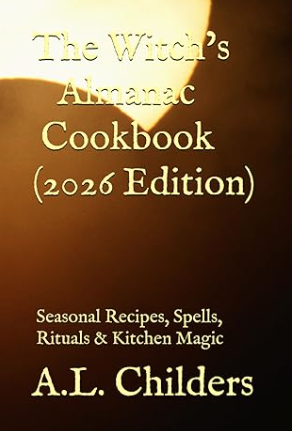
The Witch’s Almanac Cookbook (2026 Edition): Seasonal Recipes, Spells, Rituals & Kitchen Magic ( Click on this link to order yours today!)
What if your kitchen wasn’t just a place to cook—but a sacred space where energy, intention, and nourishment meet?
That’s the heartbeat of my newest creation, The Witch’s Almanac Cookbook (2026 Edition): Seasonal Recipes, Spells, Rituals & Kitchen Magic.

🍞 Not Just a Cookbook — A Spiritual Companion

Most cookbooks feed your body.
This one feeds your soul.

The Witch’s Almanac Cookbook dares to go beyond recipes and measurements—it invites you into a living rhythm where food, magic, and mindfulness intertwine. Each page is crafted as both a guide and a spellbook, meant to awaken your connection to the Earth and to yourself.

Here, the kitchen becomes your altar. The ingredients—your sacred tools.
Each meal, a manifestation of gratitude, healing, and transformation.


🌿 What Makes This Book Different

This isn’t about fancy ingredients or impossible recipes.
It’s about returning to what’s real — cooking with intention, aligning your meals with nature, and rediscovering how deeply food can heal.

Unlike other spiritual cookbooks, The Witch’s Almanac Cookbook combines:

  • 🌙 Seasonal recipes guided by the lunar cycle and elemental balance
  • 🕯️ Daily rituals and kitchen spells that blend seamlessly with modern life
  • 🌾 Herbal wisdom from centuries of folk healing traditions
  • 💫 Reflection pages for journaling your energy, blessings, and intentions

Every season of the year unfolds like a chapter of your own story—each with recipes, rituals, and reflections meant to balance your mind, body, and spirit.


🔮 Why People Need This Book

In a world obsessed with speed, this book invites you to slow down.
To feel the rhythm of nature again.
To cook not just for survival, but for sacred connection.

Whether you’re a seasoned witch, a healer, or simply someone craving a deeper way to live, this book meets you where you are. It helps you:

  • Reconnect with the natural world
  • Transform mealtime into meditation
  • Use herbs, spices, and elements to shift energy and emotion
  • Restore the lost art of intentional living

Each recipe whispers ancient wisdom—reminding you that nourishment can be a spell, and that the act of cooking can heal far more than hunger.


🕯️ A Taste of What Awaits You

Inside, you’ll find:

  • Midsummer Berry Blessing Bread – for joy, growth, and abundance
  • Autumn Hearth Stew – a grounding meal to honor release and reflection
  • Yule Cinnamon Elixir – for warmth, love, and new beginnings
  • Spring Equinox Cleansing Soup – to cleanse the spirit and awaken creativity

Every chapter mirrors the turning of the wheel of the year — from Samhain to Beltane, from solstice to equinox — reminding us that nature’s cycles live within us, too.


🌕 Why It Stands Out

Because this book isn’t just meant to be read.
It’s meant to be lived.

Each recipe is more than food — it’s a conversation with the universe, a moment of gratitude, a tiny act of rebellion against chaos.

If you’ve ever felt disconnected from your kitchen, your body, or your purpose, this is your invitation to come home — to yourself, to your roots, and to the quiet magic simmering inside you.


⚠️ Disclaimer

This book and blog are intended for educational, spiritual, and entertainment purposes only. It does not replace professional medical or nutritional advice. Always use discernment and consult qualified practitioners when necessary.


📚 References & Inspiration

  • Cunningham, Scott. Wicca in the Kitchen. Llewellyn Publications, 2002.
  • Andrews, Ted. The Magical Kitchen: Everyday Rituals and Seasonal Celebrations.
  • Farmer’s Almanac, Lunar Calendar 2025–2026.
  • A.L. Childers, Author’s Field Notes: Seasonal Energy and Food as Medicine.

✍️ About the Author

A.L. Childers is a multi-genre author, journalist, and healer who has written over 200 books blending spirituality, folklore, and real-world wisdom. Her work bridges science, spirit, and storytelling—inviting readers to find balance between the mystical and the mundane.

From Appalachian folklore to holistic healing, A.L. Childers crafts stories and guides that remind us:
✨ “Magic isn’t something you find — it’s something you remember.”


Discover The Witch’s Almanac Cookbook (2026 Edition) by A.L. Childers — a soulful blend of seasonal recipes, spells, rituals, and kitchen magic. Transform every meal into a moment of intention and connection.


The Witch’s Almanac Cookbook 2026, witchy cookbook, kitchen witch recipes, A.L. Childers, seasonal cooking, witchcraft rituals, food magic, kitchen spells, spiritual cookbooks, moon phase cooking, magical meals

✨🕯️ Banish the Bad Vibes: A Cleansing Spell to Break Negative Contacts (Plus 4 More You’ll Love)

Because sometimes, a bubble bath and a little intention can shift your entire energy field.


Discover a simple yet powerful ritual bath spell to break negative contacts, plus 4 more cleansing rituals to restore your energy, release attachments, and invite light back into your life.


🌿 The Night the Energy Felt Heavy

It was one of those evenings where the air felt thick—like the room itself was carrying someone else’s mood. I had just come home from a draining conversation that left my chest tight, my thoughts tangled. Even after the person was gone, their energy wasn’t.

I drew a hot bath. The sound of water filled the silence like a steady heartbeat. On the counter sat a small bowl of pink salts, a scoop of baking soda, and the intention that tonight…I’d let go.

As I held my right hand over the mixture, I closed my eyes and pictured a stream of white light pouring down through my palm, infusing the salts with warmth. The moment I poured them into the water, the room seemed to hum. Steam rose like a veil. I stepped in.

“As this water washes over me, I break contact with all negativity.”

I whispered it once, then again. By the third time, the heaviness had begun to loosen its grip.

🛁 Spell to Break Negative Contacts

Ingredients:

  • 1 hot bath
  • 1 cup Epsom or Dead Sea salts
  • 1 cup baking soda

Instructions:

  1. Hold your right hand over the salts and visualize purifying white light flowing into them.
  2. Pour the salts and baking soda into your bath and swirl them clockwise.
  3. Step into the bath and, as you pour water over your body, repeat aloud: “As this water washes over me, I break contact with all negativity.”
  4. Close your eyes. See yourself surrounded by a glowing white light, dissolving cords, attachments, or stagnant energy.
  5. When you’re done, drain the water and imagine everything you released swirling away down the drain.

🌿 Why this works: Ritual bathing is one of the oldest spiritual practices—used in Babylon, Ancient Greece, and Indigenous cultures—to symbolically cleanse the spirit and body. Salt neutralizes energy, while water carries it away.


🪄 4 More Cleansing Spells to Restore Your Energy

1. 🕯️ The Black Candle Burn

  • Light a black candle (symbol of banishing) and place it on a fireproof plate.
  • Write the name or situation you want to release on a small piece of paper.
  • Fold it away from you three times, place it under the candle, and let the wax drip over it as you say: “What was tied is now released. What was heavy is now light.”
  • Let the candle burn safely down. Dispose of the paper outside or bury it.

📝 Why it works: Black candles are traditionally used to absorb and neutralize negativity, making this spell a favorite for energy workers.


2. 🌬️ The Cord Cutting Visualization

  • Sit quietly. Picture a cord of energy connecting you to the person or situation.
  • Visualize holding a golden pair of scissors.
  • With love and clarity, cut the cord, watching both ends retract and heal with light.
  • Say: “I release you with love. I reclaim my energy now.”

Why it works: This method is rooted in modern energy healing but mirrors ancient symbolic “severing” rituals used across cultures to break unhealthy attachments.


3. 🍃 The Herbal Sweep

  • Bundle cleansing herbs like rosemary, lavender, sage, or cedar with a natural string.
  • Sweep the bundle gently over your body from head to toe while repeating: “With this sweep, I clear and release what does not serve me.”
  • Hang the herbs to dry outside afterward to release the absorbed energy.

🌿 Why it works: Herbal cleansing is an ancient European, Indigenous, and Mediterranean practice believed to bind and absorb negative influences.


4. 🧂 The Doorway Salt Line

  • Sprinkle a thin line of salt across doorways and windowsills while saying: “Only peace may enter here. Only love may remain.”
  • Leave overnight, then sweep up and discard outside.

🧂 Why it works: Salt has been used in folk magic, Shinto, and Mediterranean traditions to create protective barriers against negative energies and spirits.


🌐 References & Inspirations

  • Encyclopedia of 5,000 Spells by Judika Illes
  • Cunningham’s Encyclopedia of Magical Herbs
  • Historical bathing rituals in Babylon & Ancient Greece – World History Encyclopedia
  • Romani & Mediterranean folk cleansing traditions
  • Modern energy healing practices and cord-cutting visualizations

⚠️ Disclaimer

This article is intended for spiritual, cultural, and personal development purposes only. It is not medical advice. If you’re experiencing emotional or mental distress, please consult a qualified healthcare or mental health professional.


✍️ About the Author – Audrey Childers

Audrey Childers is a writer, spiritual researcher, and storyteller who blends ancient wisdom with modern life. She explores history, ritual, and personal empowerment through her books and blogs—always with a touch of magic and truth.


📸 Image Suggestions

  • A soft-lit bathroom with Epsom salts and candles (Unsplash/Pexels)
  • A black candle burning in a quiet room
  • Herbal bundles tied with twine on a rustic table
  • A symbolic image of white light surrounding a person in meditation
  • Vintage illustrations of ritual baths or salt cleansing (public domain)


bath spell to break negative contacts • cleansing rituals • energy cord cutting • salt bath spiritual • black candle banishing spell • herbal energy cleansing • spell for negative attachments • folk magic traditions • modern spiritual cleansing • Audrey Childers witchy blog

Who Were the Cathars?

The Cathars did not see themselves as revolutionaries. They saw themselves as restorers of truth — a people who remembered that this world was not holy but counterfeit, ruled by Rex Mundi, the “king of this world.” Their name, drawn from the Greek katharos (“the pure ones”), reflected their pursuit of purity of spirit, not through rituals of stone cathedrals but through simplicity, compassion, and awakening.

Rome, however, saw them as heretics of the most dangerous kind. Not because they worshipped pagan gods or practiced sorcery, but because they lived a form of Christianity so radically different that it exposed the corruption of the institutional church.

Origins: From Bogomils to Languedoc

The Cathars emerged in the 11th and 12th centuries in the region of Languedoc (southern France), a land of troubadours, merchants, and relative openness compared to northern Europe. Their roots trace to the Bogomils of the Balkans — a dualist Christian movement from Bulgaria that taught the world was created not by God, but by an evil power. These teachings spread westward along trade routes, finding fertile ground in Occitania.

By the time they took hold in Languedoc, Cathar communities had become vibrant, drawing followers across social classes — from peasants to nobles. Why here? Because Languedoc’s culture already valued tolerance, literacy, and independence from northern French control. It was a land where an alternative Christianity could thrive — at least for a time.

Perfecti vs. Credentes

The Cathar community was structured in two groups:

  • Perfecti (the Perfects): Spiritual leaders who lived in radical purity. They renounced meat, wealth, war, and sex, devoting themselves fully to the God of Light. They were seen as living examples of the awakened life.
  • Credentes (the Believers): Ordinary followers who respected the Perfecti, sought their guidance, and prepared — often at the end of life — to receive the consolamentum (a laying-on of hands seen as the true baptism of spirit).

This division wasn’t about hierarchy or domination; it was about responsibility. The Perfecti modeled the awakened life, while the Credentes lived in the world but carried the spark within them.

Ethics: Living Against the World

If the material world was a prison, then the way to resist Rex Mundi was to live as if you were no longer his subject. Cathar ethics were strikingly different from those of their Catholic neighbors:

  • Simplicity and Poverty: They rejected wealth and opulence. Unlike Rome’s bishops clothed in silk, Cathar Perfecti wore plain black robes and lived with little.
  • Vegetarianism: They abstained from meat (except fish), believing it tied them too closely to the cycle of material corruption.
  • Refusal of Oaths: They would not swear oaths, even in court, because to bind oneself to earthly rulers was to submit to the god of this world.
  • Rejection of War and Violence: They would not kill, even in self-defense, embodying a radical form of nonviolence.
  • Equality of the Sexes: Women could serve as Perfectae, and their voices carried weight equal to men — a shocking contrast to the Catholic Church’s patriarchy.

To the Catholic hierarchy, these practices were not simply “different.” They were a rebuke. Each Cathar choice highlighted the hypocrisy of a church that amassed wealth, swore oaths for political gain, blessed wars, and oppressed women.

Rex Mundi: The “God of This World”

At the center of Cathar theology was Rex Mundi — the ruler of this world. To the Cathars, he was Satan himself, the same Adversary who offered Jesus all the kingdoms of the earth in Matthew 4:8–9.

  • The Catholic Church worshipped Rex Mundi without realizing it.
  • The sacraments of Rome were traps, binding souls more tightly to the flesh.
  • True salvation lay not in building cathedrals or obeying priests, but in awakening — remembering the divine spark within and rejecting the counterfeit world.

This belief was not just theological speculation. It was a direct accusation: the church itself, with its wealth and power, was the empire of the Adversary.

Why They Thrived — and Why They Terrified Rome

The Cathars thrived in Languedoc for a simple reason: they offered an alternative Christianity that made sense to people. Ordinary believers looked at Rome’s wealth and corruption — indulgences sold, priests living in excess — and then looked at the Cathars, who lived humbly, healed the sick, and refused to kill. The choice was obvious.

  • For the people: Cathar faith gave hope and dignity. It told them they did not need middlemen to find God.
  • For local nobles: Tolerating Cathars gave them leverage against Rome. By supporting an alternative religion, they weakened papal influence in their territories.

But this success is exactly why they terrified Rome. If Cathar Christianity spread, the church stood to lose:

  • Wealth: No more tithes, indulgences, or taxes flowing to Rome.
  • Power: No more oaths binding people to papal authority.
  • Control: No more fear-driven obedience to sacraments.

Rome gained everything by destroying the Cathars — land, loyalty, and the reaffirmation of its monopoly on salvation. The Cathars lost everything — homes, lives, entire communities.

The Claim in Context

Seen from the outside, the Cathars were heretics. Seen from within, they were defenders of a Jesus who came to awaken, not to enthrone empires.

This chapter is not about romanticizing them. It is about seeing why their voice was silenced. They did not threaten God. They threatened power. And in the Middle Ages, that was enough to mark them for extermination.

Resources & References

  • Barber, Malcolm. The Cathars: Dualist Heretics in Languedoc in the High Middle Ages. Longman, 2000.
  • O’Shea, Stephen. The Perfect Heresy: The Life and Death of the Cathars. Walker & Co., 2000.
  • Wakefield, Walter L., and Austin P. Evans. Heresies of the High Middle Ages. Columbia University Press, 1991.
  • Peters, Edward. Inquisition. University of California Press, 1988.
  • Brenon, Anne. The Forgotten Cathars. Oxford, 1991.
  • Gnostic Society Library: Interrogatio Johannis (Secret Supper), translations and background.

The Forbidden Gospel of John: From Sinai to Nicaea and the Prison of Flesh

About the Author

A.L. Childers is a writer and researcher who refuses to stop at the surface of things. Her work digs into history, symbols, and the hidden stories that shape culture and politics today. By blending truth, curiosity, and raw honesty, she writes for the people who are tired of being told half-truths.


Disclaimer

This blog is for educational and historical purposes only. It does not endorse or condemn any religion, culture, or nation. Its purpose is to examine the historical and symbolic use of the hexagram and to explore how symbols move between occult traditions and cultic institutions.