
A frontier tale whispered through grass, gunmetal, and breath held too long
The land along the South Fork of the New River did not look dangerous at first glance. In spring, it rarely did. The grass lay thick and green across the Old Fields, rolling gently where timber had long ago been cleared by hand and necessity. The air smelled of damp earth and young leaves. Cattle grazed without worry. Birds carried on as if the world were not already quietly dividing itself into sides.
But in 1781, peace in the Carolina backcountry was an illusion—thin as morning fog and just as quick to burn away.
Colonel Cleveland knew this, even as his horse’s hooves pressed into the soft ground. He had come to inspect his plantation lands along the New River, accompanied only by a servant, trusting familiarity more than caution. It was a Saturday in April, the kind of day that felt ordinary enough to lower one’s guard. The river moved steadily beside them, cold and sure, reflecting a sky that gave no warning.
What Cleveland did not know—what the land itself seemed to hold its breath over—was that danger was already moving south.
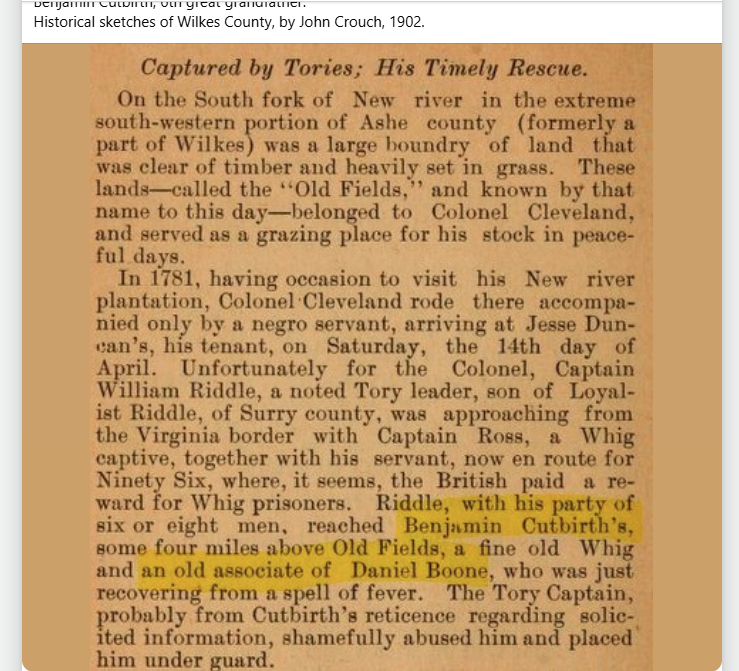
Captain William Riddle, a Tory leader hardened by allegiance to the Crown and emboldened by reward, was approaching from the Virginia border. With him rode a small party of men and a Whig prisoner, Captain Ross, bound for Ninety Six where British coin awaited those who delivered rebels alive. Their horses carried the metallic scent of sweat and leather. Their muskets knocked softly against saddles, a dull, patient sound.
By the time Riddle’s party reached the Old Fields, the grass no longer rustled with birds alone.
They reached the home of Benjamin Cutbirth—four miles above the Old Fields—a place known among Whigs as steady ground. Cutbirth himself was recovering from fever, his body still weak, his senses dulled, but his loyalty intact. Nearby was his old associate, Daniel Boone, resting briefly in familiar country, unaware that history was about to brush close enough to leave a mark.
Riddle did not ask politely.
Accounts say the Tory captain grew suspicious of Cutbirth’s silence, of his refusal to offer information. Anger came quick. Words turned sharp. Abuse followed. Then restraint. Cutbirth was placed under guard, the iron taste of fear mixing with the lingering bitterness of sickness in his mouth.
The sounds of the frontier shifted. Hooves stamped. Voices dropped. Somewhere nearby, the New River kept moving, indifferent.
And then—intervention.
Local Whigs, alerted by movement and rumor, gathered with the quiet urgency of men who knew these hills and knew what was at stake. They moved through brush and shadow, the smell of crushed pine underfoot, fingers tight around rifle stocks smoothed by years of use. When the moment came, it came fast—confusion, shouts, the crack of gunfire ripping through the calm afternoon.
Riddle’s party scattered.
Cutbirth was freed.
Ross escaped.
The land exhaled.
The Tory captain, once certain of reward and control, vanished back toward the border, leaving behind nothing but churned earth and the knowledge that allegiance in the backcountry could change with the bend of a river or the loyalty of a neighbor.
When quiet returned, it was not the same quiet as before. It was heavier. Earned. The kind that settles after danger passes close enough to be felt in the bones.
The Old Fields would remain grassed and grazing. The New River would continue its steady course. But those who lived there carried the memory—of how quickly peace could be interrupted, and how survival often depended not on armies, but on timing, terrain, and the courage of ordinary men who refused to disappear quietly.
This is how the American Revolution was truly fought—not only in grand halls or famous battles, but in places like Wilkes County, where history unfolded in breathless moments between hoofbeats and gun smoke.
Disclaimer
This blog is a historical retelling based on documented accounts and regional histories. While written in a narrative style, it reflects real events, locations, and figures from the American Revolutionary period. Some sensory details are reconstructed for storytelling purposes.
About the Author
A.L. Childers is a historical storyteller and researcher who writes at the crossroads of memory, land, and forgotten voices. Her work blends documented history with immersive narrative, bringing overlooked moments of the American past back into the light. Follow her work to explore stories where place matters, silence speaks, and history breathes.
📚 To read more historically grounded narratives, cultural investigations, and frontier stories, follow A.L. Childers and explore her books, where the past is never treated as distant or dull.
References & Resources
- John Crouch, Historical Sketches of Wilkes County (1902)
- North Carolina State Archives – Revolutionary War records
- Wilkes County Historical Society
- Ashe County Historical Resources
- Draper Manuscripts (for frontier-era corroboration)

