Motherhood is often celebrated as the ultimate expression of love, selflessness, and nurturing, but for those of us living with undiagnosed neurodivergence—whether it’s ADHD, autism, anxiety, or OCD—the experience can be a double-edged sword. It’s not something we talk about openly because the truth is uncomfortable. There’s a silent heartbreak that comes with parenting when your own brain works against you, and society isn’t ready to acknowledge it.
We’re expected to embody patience and resilience, but what happens when every day feels like a battle between your love for your children and the limits of your mental bandwidth? No one wants to talk about the days when you feel more like a failure than a mother. But we need to. For us, for our children, for every parent who feels they’re walking this path alone.
The Reality We Don’t Talk About
Behind every smiling photo on social media, there are moments that no one sees. Moments when the overstimulation becomes so intense that the sound of your child’s laughter feels like a physical ache. Or when the weight of your anxiety makes you question every decision, convinced you’re somehow damaging the very people you love the most. No one tells you about the tears you shed in secret, or the nights when guilt is the only thing keeping you awake.
There’s an emotional toll to parenting with neurodivergence that’s rarely spoken about. It’s not just the mental exhaustion, but the constant fear that your struggles will negatively affect your children. You worry that your short temper, your need for control, or your inability to handle sensory overload will leave scars on them. And because this isn’t a conversation people are comfortable with, many of us are left to carry this weight in silence.
The Unseen Toll on Relationships
Parenting while neurodivergent doesn’t just impact your relationship with your children; it can also strain your relationship with your partner. While you’re trying to manage sensory overload or executive dysfunction, your partner may not fully understand what’s happening inside your mind. The invisible battles can feel like personal failures or inadequacies, leading to frustration on both sides.
My husband and I, for example, clash often over the state of our home. Where I crave cleanliness and organization to quiet the chaos in my mind, he tends to accumulate things—what feels to me like hoarding. This tension feeds my anxiety, and it turns a space that should feel safe and nurturing into a battleground. But people don’t talk about how neurodivergence can create these rifts in a marriage, even when love is still present.
We love our families fiercely, but we struggle to express that love in ways that neurotypical parents may take for granted. And it hurts. It hurts to feel like the very traits that make us who we are also make it harder for us to be the parents we want to be.
Shame and Guilt: The Silent Shadows
Shame is perhaps the most persistent and damaging emotion for neurodivergent parents. We live in a world that places impossible expectations on mothers—perfection is often the standard, even though we all know it’s unattainable. But add undiagnosed neurodivergence into the mix, and suddenly, we feel that we’re failing not just as mothers but as human beings.
We blame ourselves for the meltdowns, the sensory overload, the times we can’t handle the simplest tasks because our brains are too overloaded. We’re told to “take a deep breath” or “relax,” but those of us who live with ADHD or autism know it’s not that simple. Our brains don’t turn off, and we don’t get to just “relax.” And the guilt—oh, the guilt—is constant.
There’s guilt over not being able to handle certain things, guilt over needing more time alone than other parents, guilt over not being able to manage emotions in the way we think we should. We apologize to our kids when we snap, then lie awake at night questioning whether we’re doing enough for them. And when we hear phrases like “all moms feel that way,” we feel unseen, because our struggles often go beyond the typical challenges of motherhood.
The Role of Perimenopause: The Unseen Aggravator
For many neurodivergent mothers, perimenopause brings another layer of emotional upheaval that no one wants to talk about. The hormonal shifts exacerbate symptoms like anxiety, irritability, and emotional dysregulation—symptoms we’re already battling. It’s a perfect storm of overstimulation, mood swings, and emotional exhaustion, and yet it’s rarely acknowledged in conversations about motherhood and mental health.
Perimenopause has been an unexpected companion on my journey, making it even harder to regulate my emotions and keep up with the demands of parenting. It’s as if my body and mind are conspiring to make an already challenging experience feel overwhelming, and yet this intersection of motherhood, neurodivergence, and perimenopause is often ignored.
Breaking the Silence for Our Children
Despite the struggles, there’s something that keeps us going: the fierce desire to do better for our children. We want to break the cycle, to teach our kids about emotions, boundaries, and self-acceptance in ways we never learned ourselves. I’ve taught my children to recognize when they’re overwhelmed, to ask for breaks, and to never feel ashamed of their feelings. I hope that by acknowledging my own struggles, I’m giving them permission to be honest about theirs.
And yet, the guilt lingers. Every time I lose my temper or shut down, I worry about the impact it has on them. But we keep moving forward. We keep apologizing, explaining, and teaching our children to be kind to themselves—hoping that someday, we’ll believe it for ourselves.
We’re Not Alone: Finding Community and Understanding
The truth is, neurodivergent mothers aren’t alone, even though it often feels that way. More and more research is emerging about the impact of neurodivergence on parenting, and resources are slowly becoming available. But we still need to talk about it. We need to break the silence surrounding the unique challenges we face and create spaces where we can share our stories without fear of judgment.
If you’re a neurodivergent mother reading this, I want you to know: You are not failing. You are navigating a path that is difficult and often isolating, but your love for your children shines through every day. Let’s continue to break the silence and build a community where our struggles are not hidden but understood, where our guilt is replaced with compassion, and where our children grow up knowing they are loved deeply by parents who are doing the best they can.
Recommended Reads:
- Silent Struggles: Navigating Parenthood with Undiagnosed Neurodivergence by A.L. Childers—A personal and professional exploration of the hidden battles faced by neurodivergent parents.
- The Mask of Motherhood: How Becoming a Mother Changes Our Brains and Our Lives by Susan Maushart—An insightful look into the psychological shifts that happen when we become mothers.
- Women with ADHD: A Life-Changing Guide to Embrace Neurodiversity, Heal Your Mind and Improve Your Self-Esteem by Taylor Alexander—A deep dive into understanding ADHD and how it affects women, especially mothers.
For more books by A.L. Childers, or to support my work in bringing attention to these issues, visit my author page or consider donating. Together, we can lift the veil on these hidden struggles and create a future where neurodivergent parents are seen, heard, and supported.
For more of my books, visit my author page on Amazon or consider donating to support my ongoing work in health, wellness, and personal development. Together, we can break the silence and create a world where neurodivergent parents feel seen, supported, and understood.
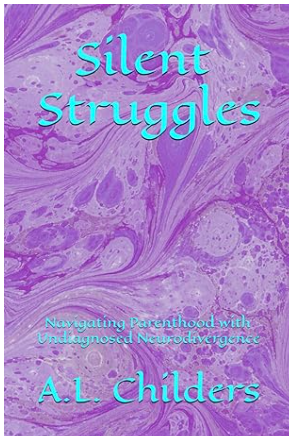
Silent Struggles: Navigating Parenthood with Undiagnosed Neurodivergence
Order your book today! Click on this link or the title link above!
Audrey Childers is an accomplished author, blogger, freelance journalist, and entrepreneur who has been writing and researching for over a decade. She is the creator and founder of Thehypothyroidismchick.com, a website that provides helpful tips for those living with hypothyroidism. Audrey loves spending time with her children and promoting optimal health and wellness for everyone. She has written over 200 books, including A survivors cookbook guide to kicking hypothyroidism booty, Reset Your Thyroid,, The Ultimate Guide to healing hypothyroidism, and A survivors cookbook guide to kicking hypothyroidism booty: the slow cooker way All of Audrey’s books can be found on Amazon. This blog can be freely re-posted with proper attribution, author bio, and copyright statement.
Thehypothyroidismchick.com is a reliable source of health and science news relevant to our generation. They cover a wide range of stories but focus on contributing to their readers’ understanding of a complex and constantly changing field of information. They are driven by two core values: to provide accurate and informative content and to keep in mind the ultimate “smell test” – stories worth discussing with friends at a bar. At Thehypothyroidismchick.com, coverage is determined based on relevance, clinical significance, and editorial integrity. They do not prioritize commercial considerations and always clearly distinguish between factual content, commentary, and opinions to avoid misleading readers with institutional propaganda and speculation. This ensures that readers can trust the information they receive and make informed decisions about their health.
Please follow along with me on this journey of discovery as I share my brush of madness with exquisite clarity. Luckily, I was never a quick fix-it junkie where I said no to many suggestions from board-certified or certifiable doctors because I felt it in my soul that it was merely a bonafide being placed on my issues. The names of sure doctors have been changed because, frankly, I don’t want to be sued for proven the lack in their field.
Hippocrates was right when he said: Let the food be thy medicine and thy medicine be thy food.
Disclaimer
The information and recipes in the blog are based on the author’s research and personal experiences. It’s for entertainment purpIt’s only. Every attempt has been made to provide accurate, up-to-date, and reliable information. No warranties of any kind are expressed or implied. Readers acknowledge that the author does not render legal, financial, medical, or professional advice. By reading this blog, the reader agrees that under no circumstance the author is not responsible for any direct or indirect loss incurred by using the information contained within this blog. Including but not limited to errors, omissions, or inaccuracies. This blog is not intended to replace what your healthcare provider has suggested. The author is not responsible for any adverse effects or consequences from using any of the suggestions, preparations, or procedures discussed in this blog. All matters about your health should be supervised by a healthcare professional. I am not a doctor or a medical professional. This blog is designed as an educational and entertainment tool only. Please always check with your health practitioner before taking any vitamins, supplements, or herbs, as they may have side effects, especially when combined with medications, alcohol, or other vitamins or supplements. Knowledge is power, educate yourself and find the answer to your healthcare needs. Wisdom is a beautiful thing to seek. I hope this blog will teach and encourage you to take leaps in your life to educate yourself for a happier & healthier life. You have to take ownership of your health.
The views and services offered by Thehypothyroidismismchick.com are not intended to be a substitute for professional medical assistance but as an alternative for those seeking solutions for better health. We do not claim to diagnose, treat, prevent, or cure any disease but simply help you make physical and mental changes in your own body to help your body heal itself. Remember that results may vary, and if you are pregnant, nursing, taking medications, or have a severe condition, you should consult a physician or other appropriate medical professional before using any products or information on this site. Thehypothyroidisimchick.com assumes no responsibility for the use or misuse of this material. Your use of this website indicates your agreement to these terms. Our full disclosure, terms of use, and privacy policy.
The information on this site is not intended or implied to be a substitute for professional medical advice, diagnosis, or treatment. All content, including text, graphics, images, and information on or available through this website, is for general information purposes only. Opinions expressed here are the opinions of the writer. Never disregard professional medical advice or delay seeking medical treatment because of something you have read or accessed through this website.
This site is designed for educational purposes only and is not engaged in rendering medical advice, legal advice, or professional services. If you feel that you have a medical problem, you should seek the advice of your physician or health care practitioner. For additional information, please see Our full disclosure, terms of use, and privacy policy.
Our full disclosure, terms of use, and privacy policy. | thehypothyroidismchick
Discover more from thehypothyroidismchick
Subscribe to get the latest posts sent to your email.


I have a similar experience as an undiagnosed autistic mom. It is definitely a tragedy disguised as a blessing.
LikeLiked by 1 person
Thank you so much for reading my blog and for sharing your experience. It truly means a lot. I completely understand how being an undiagnosed autistic mom can feel like both a tragedy and a blessing. So many people go undiagnosed, not just because of a lack of awareness but also due to financial barriers, fear of the unknown, and the complexity of truly understanding ourselves. But know this—you are not alone, and your journey matters. Your strength, resilience, and love as a mother shine through, even in the challenges. You got this! Keep pushing forward, and never doubt the value of your voice and experience. 💛
LikeLiked by 1 person
Hi there, wow! While this article has a lot of sad parts, and I really feel for you, I also admire you to talk about this. It‘s definitely necessary, but I have never heard someone so openly talk about their struggles with motherhood and neurodivergence. Thank you 🤍 I don‘t know if this in any way can help you, but as a 30-year old woman with cptsd, anxiety, depression, adhd, high sensitivity and what not, I‘m often glad that I didn‘t have children before all of this came up, and that now I get the chance to decide if I want them or not, based on all the facts I know and learn about myself.
LikeLiked by 1 person
Thank you so much for taking the time to read and respond. I truly appreciate your engagement, and more than anything, I’m grateful for you sharing your personal experience with us. It takes courage to open up, and I deeply value the trust you’ve placed in allowing us a glimpse into your life. Your story matters, and I’m honored to be part of this conversation with you.
LikeLiked by 2 people
Thank you!!
LikeLike
I can definitely relate to this post. Thank you
LikeLiked by 1 person
Thank you so much for reading and taking the time to share that with me! It means a lot to know that this resonated with you. You’re not alone in this journey, and your experiences matter. Keep going, keep growing, and never doubt the strength you carry within you. You’ve got this! 💛✨
LikeLiked by 1 person